

How Vibration Plates Support Bone Density, Joint Health & Balance for Women Over 40
Let’s talk about the fears that keep many women up at night as they age: brittle bones that fracture easily, stiff joints that limit movement, and the terrifying possibility of a fall that changes everything.
These aren’t just abstract worries, they’re real health concerns that affect millions of women over 40. Osteoporosis, arthritis, and falls are among the leading causes of disability and loss of independence in midlife and beyond.
Here’s the empowering news: you have far more control over your bone density, joint health, and balance than you might think. And one of the most effective, low-impact tools available is something that takes just 10 minutes a day, a vibration plate.
In this guide, we’ll explore exactly how vibration plates support bone strength, reduce stiffness, improve mobility, and dramatically reduce your fall risk as you age.
The Bone Density Crisis for Women Over 40
Let’s start with some sobering statistics:
- Women can lose up to 20% of their bone density in the 5-7 years following menopause
- 1 in 2 women over 50 will experience an osteoporosis-related fracture
- Hip fractures carry a 20% mortality rate within one year
- After menopause, bone loss accelerates to 1-2% per year without intervention
Why Menopause Destroys Bone Density
Estrogen is your bones’ best friend. It helps regulate osteoblasts (cells that BUILD bone) and osteoclasts (cells that BREAK DOWN bone). When estrogen plummets during menopause, this balance tips dramatically toward bone loss.
Traditional recommendations include:
- Weight-bearing exercise (walking, jogging)
- Resistance training (lifting weights)
- High-impact activities (jumping)
The problem? Many women over 40 already have joint pain, previous injuries, or conditions that make high-impact exercise uncomfortable or even harmful.
This is where vibration plates offer a revolutionary alternative.
How Vibration Plates Build Bone Density
Research from the Journal of Bone and Mineral Research demonstrates that whole body vibration training can help maintain and even improve bone mineral density in postmenopausal women, comparable to traditional weight-bearing exercise, but without the joint stress.
The Mechanism: Mechanical Loading
Your bones respond to mechanical stress by becoming stronger (Wolff’s Law). When you stand on a vibration plate:
- Rapid oscillations create mechanical loading on your skeleton
- This stimulates osteoblasts (bone-building cells)
- Increases bone mineral deposition
- Improves bone architecture and density
- All without pounding your joints
Each vibration sends a gentle “signal” to your bones: “We need to be stronger!” When done consistently, your bones respond by becoming denser.
The Research
A 2016 study in Osteoporosis International found that postmenopausal women who used vibration plates 3 times weekly for 6 months showed:
- Significant improvements in lumbar spine bone density
- Increased femoral neck (hip) bone strength
- Better results than the control group doing conventional exercise
Another study published in Bone showed that vibration therapy was particularly effective for women who couldn’t tolerate high-impact exercise.
Joint Health: Reducing Stiffness & Improving Mobility
If you wake up stiff, struggle to bend down, or feel like the Tin Man before your body “warms up, ” you’re experiencing the normal but frustrating reality of aging joints.
What Causes Morning Stiffness After 40?
- Reduced synovial fluid production: This is your joint’s natural lubricant (think WD-40 for your body)
- Fascia tightening: The connective tissue wrapping your muscles becomes less elastic
- Decreased circulation: Less blood flow means less oxygen and nutrients to joint tissues
- Mild inflammation: Low-grade inflammation accumulates in joint spaces
- Cartilage wear: Years of use naturally thin cartilage
How Vibration Plates Improve Joint Health
📺 WATCH: Reduce Stiffness & Improve Mobility
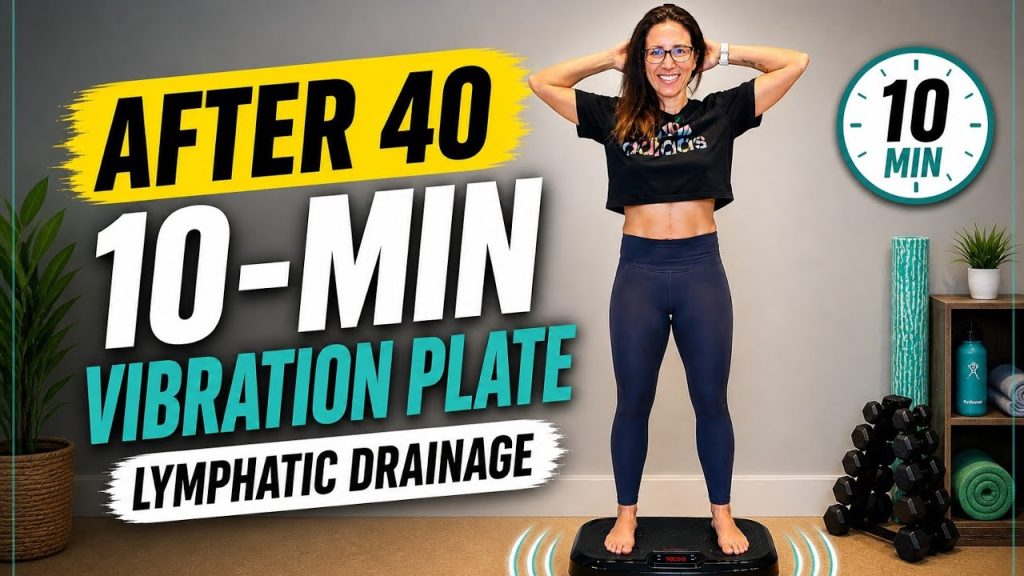
Click here to watch: https://youtu.be/bMVfBPmZKjs
This 10-minute routine helps reduce stiffness, improve joint mobility, and support circulation through simple low-impact movement perfect for women over 40.
When you use a vibration plate, several joint-beneficial things happen simultaneously:
✅ Increased synovial fluid production: The gentle oscillations stimulate your joints to produce more lubricating fluid
✅ Improved circulation: Enhanced blood flow delivers oxygen and nutrients while removing inflammatory waste products
✅ Fascia release: Vibrations help break up adhesions in connective tissue, improving flexibility
✅ Muscle warming: Rapid contractions increase tissue temperature, making movement easier
✅ Reduced inflammation: Better circulation and lymphatic drainage remove inflammatory compounds
✅ Enhanced range of motion: All of the above combine to improve how far and easily your joints can move
Morning Mobility Routine: Your Stiffness Solution
The best time to address stiffness is first thing in the morning, before it sets the tone for your entire day.
The 10-Minute Morning Protocol:
Minutes 1-3: Open lymphatic drainage points and gentle breathing
Minutes 4-6: Simple standing with gentle arm movements
Minutes 7-8: Torso twists and side bends
Minutes 9-10: Gentle squats and calf raises
This routine literally “wakes up” your body, gets fluid moving, warms tissues, and sets you up for a pain-free, mobile day.
📺 WATCH: Morning Mobility Routine
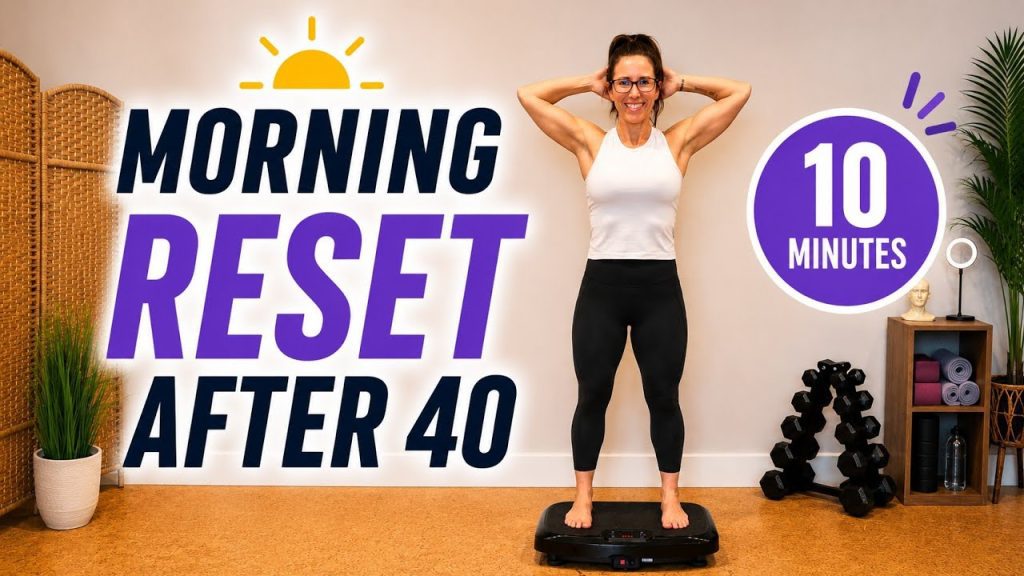
Click here to watch: https://youtu.be/Aqu1dsh3Zf0
Wake up your body and start your day feeling lighter, more mobile, and energized. This morning routine combines vibration plate exercises with lymphatic drainage movements to reduce bloating, improve circulation, and support mobility.
Balance & Fall Prevention: Why This Matters More Than You Think
Here’s a statistic that should get your attention: falls are the leading cause of injury-related death in women over 65.
Even non-fatal falls can be life-changing:
- Hip fractures often lead to loss of independence
- Fear of falling causes many women to limit activity (which ironically increases fall risk)
- Recovery from fall-related injuries takes much longer after 40
Why Balance Declines After 40
- Proprioception decreases: Your body’s sense of where it is in space diminishes
- Reaction time slows: Neural pathways aren’t as fast
- Muscle strength declines: Particularly the small stabilizer muscles
- Vision changes: Depth perception and peripheral vision worsen
- Inner ear function: Vestibular system becomes less efficient
- Medications: Many common medications affect balance
The Vibration Plate Balance Solution
Research published in Age and Ageing found that vibration plate training reduced fall risk by up to 30% in older adults.
Here’s why vibration plates are so effective for balance:
✅ Activates stabilizer muscles: The small, deep muscles that keep you upright fire constantly to counteract vibrations
✅ Improves proprioception: Your nervous system gets better at sensing body position
✅ Strengthens ankles: Ankle stability is critical for preventing falls
✅ Enhances neuromuscular coordination: Your brain and muscles communicate more efficiently
✅ Builds confidence: As balance improves, fear of falling decreases
Even simple standing on a vibration plate challenges your balance system in ways that flat-surface exercises cannot. It’s like balance training on “hard mode”, but safely, with something to hold onto if needed.
📺 WATCH: Balance & Stability Workout

Click Here to watch: https://www.youtube.com/watch?v=zOi3XEsi-K8
This routine combines gentle balance and stability exercises on the vibration plate to help improve coordination, activate stabilizing muscles, and reduce fall risk while supporting lymphatic drainage.
Optimal Settings for Bone & Joint Health
For Bone Density:
- Frequency: 20-35 Hz (medium to high)
- Amplitude: Medium to high
- Duration: 10-15 minutes
- Frequency of use: 3-5 times weekly
- Positions: Weight-bearing (standing, squatting, lunges)
For Joint Mobility & Stiffness:
- Frequency: 10-20 Hz (low to medium)
- Amplitude: Low to medium
- Duration: 10-15 minutes
- Frequency of use: Daily is ideal, especially mornings
- Positions: Varied, including seated if needed
For Balance Training:
- Frequency: 15-25 Hz (medium)
- Amplitude: Medium
- Duration: 10-15 minutes
- Frequency of use: 4-5 times weekly
- Positions: Standing on one leg, narrow stance, eyes closed (advanced)
Specific Joint Concerns
Knee Arthritis
Vibration plates can help strengthen the muscles around your knees without the impact of walking or stairs. Stronger quads and hamstrings take pressure off knee joints.
Best exercises: Gentle squats, seated leg extensions, standing with soft knees
Hip Stiffness
Hip mobility is crucial for functional movement. Vibration enhances hip flexor release and strengthens hip stabilizers.
Best exercises: Standing hip circles, gentle lunges, side-to-side weight shifts
Lower Back Pain
Core strengthening on the vibration plate helps support your spine without crunches or heavy lifting.
Best exercises: Standing core engagement, gentle pelvic tilts, torso rotations
Shoulder Tension
Upper body movement on the vibration plate releases fascial restrictions and improves shoulder mobility.
Best exercises: Arm circles, shoulder rolls, gentle pressing movements
The Fascia Connection
Fascia is the connective tissue that wraps every muscle, organ, and structure in your body. When it becomes tight or restricted (through aging, sedentary lifestyle, or dehydration), it:
- Limits range of motion
- Creates pain and stiffness
- Restricts lymphatic flow
- Reduces circulation
Vibration plates help release fascial restrictions through:
- Increased tissue temperature
- Improved hydration of tissues
- Breaking up adhesions
- Enhanced elasticity
Many women combine foam rolling with vibration plate work for even better fascia release and mobility gains.
Building a Bone & Joint Support Practice
Weekly Schedule Example:
Monday: Morning mobility routine (10 min)
Tuesday: Balance & stability workout (10 min)
Wednesday: Bone-building routine with higher frequency (12 min)
Thursday: Gentle joint mobility and fascia release (10 min)
Friday: Balance & stability workout (10 min)
Saturday: Bone-building routine (12 min)
Sunday: Gentle recovery or rest
Progression Timeline:
Weeks 1-4: Focus on consistency and proper form
Weeks 5-8: Gradually increase intensity and challenge balance
Weeks 9-12: Add single-leg exercises and closed-eye balance work
Month 4+: Maintain routine, track measurable improvements
Complementary Practices for Maximum Benefit
Nutrition for Bones & Joints:
- Calcium: 1, 200 mg daily (from food + supplements if needed)
- Vitamin D: 1, 000-2, 000 IU daily (get levels tested)
- Vitamin K2: Helps direct calcium to bones
- Magnesium: Critical for bone structure
- Omega-3 fatty acids: Reduce joint inflammation
- Collagen peptides: Support cartilage and connective tissue
Lifestyle Factors:
- Sunlight exposure: 15-20 minutes daily for vitamin D
- Quality sleep: Recovery and repair happen during sleep
- Stress management: Chronic stress accelerates bone loss
- Adequate protein: 0.8-1g per pound of body weight for muscle maintenance
- Hydration: Essential for synovial fluid and fascia health
Safety Considerations
While vibration plates are generally safe, consult your doctor if you have:
- Severe osteoporosis: May need to start very gently
- Recent fractures: Wait until fully healed
- Joint replacements: Usually okay, but get clearance first
- Acute joint inflammation: Wait until inflammation subsides
Never push through sharp pain. Some muscle fatigue is normal; joint pain is not.
Real Women, Real Results
“I was diagnosed with osteopenia at 52. My doctor said I needed weight-bearing exercise, but running hurt my knees. The vibration plate has been perfect, my last bone density scan showed improvement for the first time in years!” , Susan, 55
“I couldn’t touch my toes or get down on the floor to play with my grandkids. After 8 weeks of daily morning vibration plate routines, my flexibility has improved dramatically. I feel 10 years younger.” , Margaret, 58
“I fell twice last year and was terrified it would keep happening. The balance work on the vibration plate has made me so much more stable and confident. I’m hiking again!” , Joyce, 61
Your Bone, Joint & Balance Action Plan
This Week:
- ✅ Try the morning mobility routine 4 times
- ✅ Notice how your joints feel, stiffness, range of motion, pain levels
- ✅ Ensure adequate calcium and vitamin D intake
This Month:
- ✅ Establish 4-5 weekly sessions focused on bone and joint health
- ✅ Add balance challenges gradually
- ✅ Track improvements (Can you reach farther? Stand on one leg longer?)
Long-Term:
- ✅ Make this a non-negotiable daily practice
- ✅ Get bone density tested (baseline and annually)
- ✅ Continue challenging yourself with progressive exercises
- ✅ Celebrate your strength and mobility gains!
Ready to Build Stronger Bones & Better Balance?
Your next steps:
- ✅ Try the morning mobility routine tomorrow
- ✅ Do the balance & stability workout 2x this week
- ✅ Subscribe to Hope Zvara on YouTube for more bone and joint health routines
- ✅ Read Blog 4 to learn about muscle toning and stress relief
- ✅ Schedule your next bone density test
Remember: Your bones respond to consistent mechanical stress. Your joints thrive on regular, gentle movement. Your balance improves with challenge. Give your body what it needs, and it will reward you with strength, stability, and confidence for decades to come.
Subscribe to Hope Zvara on YouTube for:
- Bone-building vibration plate routines
- Joint mobility and flexibility workouts
- Balance and fall prevention exercises
- Functional fitness for women over 40
👉 https://www.youtube.com/@HopeZvara
Disclaimer: This information is for educational purposes only and not medical advice. Always consult your healthcare provider before starting any new exercise program, especially with osteoporosis, recent fractures, joint replacements, or other bone/joint conditions. Get appropriate medical screening and clearance. Individual results may vary.
About Hope Zvara:
Hope Zvara empowers women over 40 with accessible wellness practices focusing on lymphatic health, functional fitness, and healthy aging. Her YouTube channel features guided routines combining vibration plates, yoga, mobility work, and strength training for midlife wellness.