
by Hope Zvara | Sep 9, 2026 | Mental Health, Self-Care, Wellness Wednesday
Emotional Boundaries: Learning to Stop Being the Punching Bag
I hung up the phone this morning and all I could think was:
This is what emotional and mental mistreatment can feel like.
This is how people can spend years in unhealthy patterns and relationships and somehow walk away from an interaction thinking, That was my fault.
Was there a miscommunication?
Yes.
Does that excuse how someone chooses to speak to you?
No.
And that’s one of the things I’ve been learning about emotional and mental mistreatment.
It can be sneaky.
It’s not always screaming, name-calling, or something another person would immediately recognize as unhealthy.
Sometimes it’s subtle.
You find yourself continually making excuses for someone’s behavior.
You replay conversations over and over, trying to figure out what you did wrong.
You start questioning what you heard, how you said something, or whether maybe you really are the problem.
Slowly, you take on more and more responsibility for interactions that require two people.
And somewhere along the way, you can lose sight of where your responsibility ends and someone else’s begins.
Awareness Is Not Blame
This isn’t a story about diagnosing someone or labeling a relationship.
It’s a story about awareness.
I’ve known for years that a large portion of my childhood was spent in an emotionally and mentally unsettled household.
I was loved.
And I still love my family deeply.
But that doesn’t mean everything was healthy or that it always felt safe.
Both things can be true.
I began understanding some of this early in adulthood as I started peeling back the layers of why I fell into unhealthy patterns and what triggered some of my own struggles along the way.
I don’t have institutional authority or professional credentials on this subject.
What I do have is a lifetime of experience working through my own stuff.
And one thing I’ve learned is that anything you’re trying to unlearn, overcome, let go of, or even simply understand rarely disappears overnight.
You can pray for something to be removed from your life.
And maybe it is.
But I’ve found that even when the thing itself is gone, the residuals can remain.
The reactions.
The thought patterns.
The triggers.
The stories you’ve learned to tell yourself.
Those things can still require attention, work, effort, prayer, forgiveness, and a whole lot of undoing.
That’s where awareness becomes so important.
Because awareness isn’t blame.
Blame Can Keep You Stuck
I actually believe blame can become one of the biggest roadblocks to healing.
There is a difference between acknowledging what happened to you and deciding that what happened to you gets to control the rest of your life.
Blame keeps you looking backward.
Awareness helps you understand what happened so you can decide what happens next.
And that’s a powerful distinction.
You can recognize that something affected you without allowing it to define you.
You can acknowledge that someone hurt you without making their behavior the center of your entire life.
You can understand where a pattern came from while still deciding that the pattern stops with you.
That doesn’t mean it’s easy.
It means you’re becoming aware.
Learning What a Boundary Actually Is
At some point several years ago, I realized I needed to slide to the other side of the table.
I started learning about boundaries.
Nothing like being a thirty-something adult trying to figure out what the hell a boundary actually is.
How do you set one?
How do you say one?
How do you hold one?
And perhaps even more importantly, how do you understand one?
I’ve also become accustomed to some pretty deep self-reflection.
Sometimes too much.
There are moments when I need to call a timeout on myself because I can analyze an interaction so deeply that I end up turning everything back onto me.
And that’s an important lesson too.
Self-reflection is healthy. Self-blame is not the same thing.
Taking responsibility for your behavior doesn’t mean taking responsibility for someone else’s.
You can ask yourself:
Did I contribute to this?
Was there something I could have handled differently?
Do I owe someone an apology?
Those are healthy questions.
But you can also ask:
Am I taking responsibility for something that isn’t mine?
That’s where boundaries begin to matter.
The Moment I Realized I Didn’t Need to Defend Myself
Which brings me back to this morning.
“Hello?”
Long pause.
Nothing.
A little louder:
“What’s up?”
Then suddenly I’m being told, in a raised voice, to stop yelling.
Ummm…
You called me.
I calmly but firmly ended the conversation and asked the other person to call me back when they were ready to speak to me calmly and respectfully.
The phone rang again.
I answered.
The conversation quickly returned to how I had supposedly been yelling.
My first instinct was to defend myself.
To explain.
To prove that wasn’t what happened.
Then I remembered something from church the day before.
It was about being a peacemaker and recognizing that sometimes our need to be right does nothing more than feed our ego.
So I dropped it.
I didn’t agree.
I didn’t admit to something I didn’t believe happened.
I simply decided that I didn’t need to convince the other person that my version was the right one.
There is a difference.
You Don’t Always Have to Prove Your Version
That moment taught me something.
What the conversation was actually about doesn’t matter nearly as much as what happened inside of me afterward.
It was almost like I was watching myself have the conversation.
I was listening to myself listening.
And I noticed something.
I wasn’t reacting the way I used to.
I got off the phone and cried.
Don’t feel bad for me.
I wasn’t crying because I felt sorry for myself.
I cried because I’m tired of being treated this way.
And maybe that’s what boundaries eventually become.
Not punishment.
Not revenge.
Not cutting people off simply because they upset you.
Sometimes boundaries are simply reaching a place where you can love someone and simultaneously decide that you will no longer volunteer to be the punching bag for the parts of themselves they haven’t dealt with.
Someone Can Love You and Still Hurt You
Here’s another hard thing I’ve learned.
Someone can love you and still have absolutely no idea how to share love, speak in love, or offer love in a healthy way.
Maybe they were caught in a loop much like you were.
Maybe nobody ever showed them another way.
Maybe they never recognized it.
Maybe they did and don’t want to change it.
I don’t know.
And I’m learning that I don’t need to know.
Their healing is not my responsibility.
But my participation is.
That’s where boundaries become powerful.
You can’t control whether someone changes.
You can’t make someone recognize their behavior.
You can’t force someone to communicate differently.
But you can decide what you will participate in.
Walking Away Isn’t Always the Answer
Some of you reading this are probably thinking:
Hope, just walk away. It’s not worth it.
And sometimes, absolutely.
There are situations where distance and safety need to come first.
But I don’t believe walking away is always the answer.
Sometimes the work is learning how to remain connected without continuing to participate in the same unhealthy pattern.
In this particular situation, walking away isn’t the choice I want to make.
Learning not to be a punching bag is.
Holding boundaries is.
Holding others accountable while continuing to hold myself accountable is.
And perhaps most importantly, working like hell to stop my own mind from twisting everything up inside of me until I’ve somehow convinced myself that I am always the problem.
Accountability Still Matters
Am I perfect?
Absolutely not.
Do I get it right all the time?
Nope.
Have I made mistakes?
A shit ton.
Have I spoken to people in ways I regret?
Yes.
But I’ve tried to learn from it.
I’ve sought to grow.
I’ve tried to change.
I’ve apologized when needed.
I’ve tried to become a better version of myself than I was yesterday.
That’s the difference I’m trying to focus on.
Boundaries aren’t about pretending you’re perfect.
They’re about being willing to hold yourself accountable without taking responsibility for everything someone else does.
You can own your mistakes without owning someone else’s behavior.
The “After Wave” Can Be Just as Exhausting
Right now, one of the hardest things I’m working on is not getting pulled into what I call the after wave.
You know the one.
The interaction happens.
Then the other person immediately starts telling everyone around them their version of the story.
Maybe it’s to justify what happened.
Maybe it’s to feel better about themselves.
Maybe they genuinely experienced the situation differently.
Whatever the reason, suddenly you feel this overwhelming need to run around correcting the record.
“That’s not what happened!”
“That’s not what I said!”
“You’re not hearing the whole story!”
I’ve done that.
I’ve exhausted myself trying to repaint a picture someone else painted of me.
And I’m learning to stop.
Breathe.
Let it happen.
Let their version exist.
Let the cards fall where they fall.
Because I know who I am.
I know what I said.
I know what I’m working on.
I know where I’ve screwed up.
And I know where I’ve grown.
You Don’t Have to Correct Every Story About You
Many of us have experienced something similar.
Someone painted a picture of you using the wrong brushes and the wrong paint, and everything inside you wanted to grab the brush out of their hand and fix it.
I’ve had that happen more than once over the years.
I’ve even had relationships change or disappear because of someone else’s version of me.
That hurts.
But I’ve learned that sometimes you have to let their paint dry and leave the picture hanging exactly as they painted it.
You don’t have to keep painting over it.
You don’t have to convince everyone.
You don’t have to chase people down and make them understand.
You can move forward.
You can let go.
You can continue to self-reflect.
You can hold yourself accountable.
You can apologize when you need to.
You can hold your boundaries when you need to.
And you can learn whatever you can from the gift of a really shitty situation.
Your Healing Doesn’t Require Everyone to Understand You
Maybe the goal isn’t to make sure everyone understands your side.
Maybe the goal is to understand yourself well enough that someone else’s version of you no longer determines who you believe you are.
That’s a different kind of freedom.
It doesn’t mean you don’t care.
It doesn’t mean you don’t acknowledge mistakes.
It doesn’t mean you stop growing.
It means you stop handing other people the authority to define you.
You know yourself.
You know what you’re working on.
You know where you’ve grown.
You know where you still have work to do.
And you can continue doing that work without constantly defending your character.
Maybe This Is How the Loop Stops
Sometimes healing isn’t about getting the other person to change.
Sometimes it’s about changing your participation in the pattern.
You recognize the trigger.
You notice your reaction.
You pause.
You choose a different response.
You establish a boundary.
You take responsibility for your part.
And you release what isn’t yours.
The other person may never understand.
They may never apologize.
They may tell the story differently.
They may continue doing exactly what they’ve always done.
But you don’t have to continue being the same person inside the cycle.
The loop can stop with you.
Not because the other person changed.
Because you did.
You May Also Like
Why Intuition Is Your Most Underrated Business Tool
Learn how intuitive leadership improves clarity and decision-making in complex environments.
🔗 https://hopezvara.com/why-intuition-is-your-most-underrated-business-tool
🌐 https://hbr.org/2022/03/how-to-stop-overthinking-and-start-trusting-your-gut
From Burnout to Breakthrough: Wellness Habits That Actually Stick
Explore how nervous system regulation supports sustainable leadership performance.
🔗 https://hopezvara.com/from-burnout-to-breakthrough-wellness-habits-that-actually-stick
🌐 https://www.mayoclinic.org/healthy-lifestyle/stress-management/basics/stress-basics/hlv-20049495
The Hidden Power of Breathwork for Entrepreneurs
Discover why breathwork is a foundational tool for regulated leadership.
🔗 https://hopezvara.com/the-hidden-power-of-breathwork-for-entrepreneurs
🌐 https://www.ncbi.nlm.nih.gov/pmc/articles/PMC6137615/
Creating a Morning Routine That Aligns With Your Purpose
Learn how intentional rituals support heart-centered leadership.
🔗 https://hopezvara.com/creating-a-morning-routine-that-aligns-with-your-purpose
🌐 https://www.psychologytoday.com/us/basics/habit-formation

by Hope Zvara | Aug 26, 2026 | Inspirational, Self-Care, Wellness Wednesday, Working With Hope
Why Clarity Is More Valuable Than Confidence
For years, we’ve been told that confidence is the secret to success.
“Be more confident.”
“Fake it until you make it.”
“Confidence is everything.”
While confidence certainly has its place, I’ve discovered something much more valuable through years of entrepreneurship, leadership, and teaching mindful movement.
Clarity beats confidence every single time.
You can be incredibly confident and still head in the wrong direction.
You can confidently launch the wrong product, say yes to the wrong opportunity, or continue working toward goals that no longer align with who you’ve become.
On the other hand, when you have clarity, you don’t need to force confidence.
Your next step becomes obvious.
Your decisions become easier.
Your energy becomes focused.
And that’s where real growth begins.
Confidence Comes and Goes
Confidence isn’t constant.
Some days you’ll feel unstoppable.
Other days you’ll question everything.
That’s part of being human.
Many entrepreneurs wait until they “feel confident enough” before launching a business, speaking on stage, raising their prices, or trying something new.
The problem is that confidence usually follows action-not the other way around.
If you wait for confidence to arrive before moving forward, you may spend years standing still.
Clarity allows you to move even when confidence isn’t at its highest.
Clarity Creates Better Decisions
Every day, entrepreneurs make countless decisions.
Should I launch now?
Should I hire someone?
Is this partnership right for me?
Should I pivot my business?
Without clarity, every decision feels overwhelming.
With clarity, decisions become simpler because they’re guided by your values, your purpose, and your long-term vision instead of fear or outside opinions.
Clarity acts like a compass.
Confidence simply gives you the courage to keep walking.
You need both-but clarity should always lead.
Noise Makes Clarity Hard to Find
Today’s world is full of distractions.
Social media tells you to do more.
Marketing experts promise overnight success.
Everyone seems to have an opinion about how you should run your business.
If you constantly consume everyone else’s advice without creating space to hear yourself think, it’s easy to lose your own direction.
Sometimes the greatest business strategy isn’t learning something new.
It’s becoming quiet enough to remember what you already know.
Your Body Often Knows Before Your Mind
One of the greatest lessons movement has taught me is that wisdom doesn’t only live in our thoughts.
It lives in our bodies, too.
Have you ever felt tension when saying yes to something you didn’t truly want?
Or felt peace after making a decision that aligned with your values?
Those signals matter.
Your nervous system is constantly giving you information.
The more regulated your body becomes, the easier it is to recognize what feels aligned and what doesn’t.
That’s why movement, breathwork, and mindfulness aren’t separate from business.
They support better leadership.
Clarity Requires Space
You can’t create clarity while constantly rushing.
If every moment is filled with meetings, emails, notifications, and endless to-do lists, your mind never has an opportunity to process.
Some of my best ideas haven’t come while sitting at my desk.
They’ve come while:
- Walking outdoors
- Practicing yoga
- Breathing deeply
- Driving quietly
- Journaling
- Sitting in stillness
Space creates perspective.
Perspective creates clarity.
Stop Chasing Every Opportunity
Not every opportunity deserves your attention.
When you’re unclear about your direction, everything looks important.
When you’re clear, saying no becomes much easier.
You begin asking questions like:
- Does this align with my mission?
- Does it support the life I’m creating?
- Will it serve the people I’m called to help?
- Does this feel like expansion or distraction?
Clarity protects your time, your energy, and your peace.
Clarity Helps You Lead Others
Whether you lead a business, a team, or a community, people naturally follow leaders who know where they’re going.
That doesn’t mean having every answer.
It means communicating with honesty and purpose.
People are inspired by leaders who make thoughtful decisions, remain grounded during uncertainty, and lead with authenticity.
Clarity builds trust.
Wellness Supports Clear Thinking
Your ability to think clearly is directly connected to how well you care for yourself.
When you’re exhausted, overwhelmed, or constantly stressed, decision-making becomes harder.
Supporting your well-being through:
- Regular movement
- Quality sleep
- Proper nutrition
- Mindfulness
- Breathwork
- Recovery
helps create the mental clarity needed to lead effectively.
Business growth begins with personal well-being.
Progress Begins With One Clear Step
Many entrepreneurs delay action because they’re trying to see every step before taking the first one.
Clarity doesn’t always reveal the entire path.
Often, it simply reveals the next step.
Take that step.
Then the next one becomes visible.
Momentum is built through action, not certainty.
Final Thoughts
Confidence may help you walk into the room.
But clarity determines where you’re going once you get there.
As entrepreneurs, leaders, and wellness advocates, we don’t need to know everything before we begin.
We simply need enough clarity to take the next aligned step.
When your decisions are rooted in purpose instead of pressure, your business grows with greater intention, your leadership becomes more authentic, and success feels far more sustainable.
Don’t spend all your energy trying to become more confident.
Spend time becoming more clear.
Everything else becomes easier from there.
You May Also Like
1. Want to Start the Year with More Calm?
Read: The Hidden Power of Breathwork for Entrepreneurs
Internal link:
https://hopezvara.com/the-hidden-power-of-breathwork-for-entrepreneurs
Explore daily breathwork practices that gently regulate the nervous system.
External Resource:
https://www.health.harvard.edu/mind-and-mood/six-relaxation-techniques-to-reduce-stress
2. Ready to Lead Without Burning Out?
Read: From Burnout to Breakthrough: Wellness Habits That Actually Stick
Internal link:
https://hopezvara.com/from-burnout-to-breakthrough-wellness-habits-that-actually-stick
Discover habits that help entrepreneurs build sustainable energy and resilience.
External Resource:
https://www.apa.org/topics/stress
3. Curious How Intuition Supports Better Business Decisions?
Read: Why Intuition Is Your Most Underrated Business Tool
Internal link:
https://hopezvara.com/why-intuition-is-your-most-underrated-business-tool
Learn how nervous system safety improves clarity and instinct.
External Resource:
https://www.psychologytoday.com/us/basics/intuition
4. Want More Focus and Less Overwhelm?
Read: Creating a Morning Routine That Aligns With Your Purpose
Internal link:
https://hopezvara.com/creating-a-morning-routine-that-aligns-with-your-purpose
See how mindfulness brings balance to demanding leadership roles.
External Resource:
https://www.mindful.org

by Hope Zvara | Aug 19, 2026 | Physical Health Benefits, Self-Care, Wellness Wednesday, Working With Hope
Why Recovery Is the Missing Piece of Fitness
When most people think about getting healthier, they think about doing more.
More workouts.
More miles.
More weights.
More intensity.
More hustle.
As entrepreneurs, coaches, and high achievers, we’re conditioned to believe that success comes from constantly pushing harder. That same mindset often spills into our fitness routines, where we wear exhaustion like a badge of honor.
But here’s the truth I’ve learned through years of teaching movement and working with people at every stage of their wellness journey:
Your body doesn’t become stronger during your workout. It becomes stronger during recovery.
Movement creates the opportunity for change. Recovery is where that change actually happens.
If you’re always pushing but rarely pausing, you may be missing one of the most important pieces of your wellness puzzle.
Recovery Is Part of the Process
Many people think recovery means taking a day off because they’re tired.
In reality, recovery is an essential part of every healthy lifestyle.
Every workout creates small amounts of stress within your muscles and nervous system.
Recovery gives your body the opportunity to:
- Repair muscle tissue
- Restore energy
- Reduce inflammation
- Improve mobility
- Strengthen the immune system
- Support hormone balance
- Build resilience
Without recovery, your body stays in a constant state of stress.
Eventually, that catches up with you.
More Isn’t Always Better
Our culture celebrates being busy.
We often believe that if one workout is good, two must be better.
If we skip a rest day, we’ll make faster progress.
But constantly training without allowing your body to recover can actually slow your results.
Overtraining may lead to:
- Persistent fatigue
- Poor sleep
- Increased soreness
- Lower motivation
- Reduced performance
- Higher injury risk
- Weakened immune function
Progress doesn’t come from doing more.
It comes from finding the right balance.
Your Nervous System Needs Recovery Too
Recovery isn’t just physical.
Your nervous system works just as hard as your muscles.
Running a business, managing a team, raising a family, making decisions, and handling daily responsibilities all place demands on your nervous system.
When you’re constantly operating in “go mode,” your body struggles to fully recover.
That’s why true recovery includes calming your mind as much as restoring your body.
Practices like mindful breathing, meditation, gentle yoga, and spending time in nature help shift your nervous system into a state where healing can occur.
Sleep Is Your Greatest Recovery Tool
If I could recommend just one recovery habit, it would be prioritizing sleep.
Quality sleep supports nearly every function in the body.
During sleep, your body works to:
- Repair muscles
- Consolidate memory
- Balance hormones
- Strengthen immunity
- Regulate metabolism
- Restore mental focus
No supplement or workout can replace the benefits of consistent, quality sleep.
If you’re sacrificing sleep to be more productive, you may actually be working against yourself.
Active Recovery Counts
Recovery doesn’t always mean sitting still.
In fact, gentle movement often helps your body recover more effectively.
Active recovery may include:
- Walking
- Gentle yoga
- Stretching
- Mobility exercises
- Light cycling
- Using a vibration plate
- Deep breathing exercises
These activities improve circulation while reducing stiffness and supporting muscle recovery.
Movement can help your body heal.
Listen to What Your Body Is Telling You
One of the greatest wellness skills you can develop is learning to listen.
Your body often tells you exactly what it needs.
Signs you may need more recovery include:
- Constant soreness
- Feeling exhausted after workouts
- Trouble sleeping
- Irritability
- Lack of motivation
- Frequent illness
- Difficulty concentrating
These aren’t signs of weakness.
They’re signals asking for rest and restoration.
Nutrition Supports Recovery
What you eat after movement matters just as much as the workout itself.
Your body needs quality nutrients to rebuild and repair.
Focus on:
- Lean protein
- Colorful fruits and vegetables
- Healthy fats
- Whole grains
- Plenty of water
Fueling your body well helps maximize the benefits of your movement practice.
Recovery Builds Consistency
One of the biggest misconceptions about recovery is that it slows progress.
The opposite is true.
When you recover well, you’re able to:
- Exercise more consistently
- Prevent injuries
- Stay motivated
- Maintain higher energy
- Enjoy movement
Fitness isn’t about one incredible workout.
It’s about creating habits you can sustain for years.
Recovery makes consistency possible.
Wellness Is About Longevity
I don’t teach movement so people can survive one intense workout.
I teach movement so they can move well for life.
The goal isn’t to push your body until it breaks.
The goal is to care for your body so it continues supporting you for decades to come.
That requires recovery.
It requires slowing down enough to let your body catch up with all the good work you’re asking it to do.
Final Thoughts
Fitness isn’t just built in the moments when you’re moving.
It’s built in the moments when you’re resting, recovering, and allowing your body to heal.
Recovery isn’t lazy.
Recovery is productive.
It’s one of the most powerful investments you can make in your health, your energy, and your future.
So the next time you plan your workouts, don’t forget to schedule your recovery too.
Because lasting wellness isn’t created by doing more.
It’s created by doing what your body truly needs.
You May Also Like
1. Want to Start the Year with More Calm?
Read: The Hidden Power of Breathwork for Entrepreneurs
Internal link:
https://hopezvara.com/the-hidden-power-of-breathwork-for-entrepreneurs
Explore daily breathwork practices that gently regulate the nervous system.
External Resource:
https://www.health.harvard.edu/mind-and-mood/six-relaxation-techniques-to-reduce-stress
2. Ready to Lead Without Burning Out?
Read: From Burnout to Breakthrough: Wellness Habits That Actually Stick
Internal link:
https://hopezvara.com/from-burnout-to-breakthrough-wellness-habits-that-actually-stick
Discover habits that help entrepreneurs build sustainable energy and resilience.
External Resource:
https://www.apa.org/topics/stress
3. Curious How Intuition Supports Better Business Decisions?
Read: Why Intuition Is Your Most Underrated Business Tool
Internal link:
https://hopezvara.com/why-intuition-is-your-most-underrated-business-tool
Learn how nervous system safety improves clarity and instinct.
External Resource:
https://www.psychologytoday.com/us/basics/intuition
4. Want More Focus and Less Overwhelm?
Read: Creating a Morning Routine That Aligns With Your Purpose
Internal link:
https://hopezvara.com/creating-a-morning-routine-that-aligns-with-your-purpose
See how mindfulness brings balance to demanding leadership roles.
External Resource:
https://www.mindful.org

by Hope Zvara | Jul 22, 2026 | Self-Care, Wellness Wednesday, Working With Hope
What Is a Vibration Plate?
Have you ever seen someone standing, stretching, or exercising on a platform that gently vibrates and wondered what it actually does?
You’re not alone.
Vibration plates have become increasingly popular in homes, gyms, rehabilitation clinics, and wellness centers. From athletes and physical therapists to busy professionals and adults looking for low-impact ways to stay active, more people are discovering the unique benefits of vibration training.
But despite its growing popularity, many people still ask the same question:
What is a vibration plate?
Is it simply another fitness trend, or is there real science behind it?
The answer may surprise you.
A vibration plate is much more than a workout machine. It’s a wellness tool that encourages your muscles to work more efficiently, improves circulation, supports balance, and helps people of all fitness levels move their bodies in a gentle yet effective way.
Let’s take a closer look at how vibration plates work and why they may become one of your favorite tools for improving your health.
What Exactly Is a Vibration Plate?
A vibration plate is a fitness platform that produces rapid vibrations while you stand, sit, or perform exercises on it.
As the platform vibrates, your muscles naturally contract and relax many times per second in response to the movement.
This automatic muscle activation is called the tonic vibration reflex.
Instead of consciously thinking about every muscle contraction, your body responds automatically to maintain balance and stability.
These tiny contractions engage multiple muscle groups simultaneously, making even simple movements more effective.
Whether you’re standing, stretching, squatting, or performing yoga poses, the vibration encourages your muscles to work a little harder without adding significant stress to your joints.
How Does a Vibration Plate Work?
The science behind vibration training is surprisingly simple.
As the platform moves, it creates gentle instability.
Your brain recognizes these vibrations and immediately signals your muscles to stabilize your body.
This happens incredibly fast—often dozens of times every second.
The result is increased muscle activation throughout your body.
Rather than replacing exercise, vibration plates enhance movement by helping your body recruit more muscles while performing familiar activities.
This makes vibration plates especially attractive for individuals who:
- Want low-impact exercise
- Are returning from injury
- Spend long hours sitting
- Want to improve balance
- Are looking to support healthy aging
- Have limited time for workouts
The Science Behind Vibration Training
Whole Body Vibration (WBV) has been studied for decades.
Researchers have explored its potential benefits for:
- Muscle strength
- Bone health
- Balance
- Flexibility
- Circulation
- Recovery
- Mobility
According to research published by the National Institutes of Health (NIH), whole-body vibration may improve muscle performance, physical function, and balance in various populations when combined with regular physical activity.
Additional studies suggest vibration training may also help older adults maintain functional mobility and reduce the risk of falls.
Like any wellness tool, results depend on consistency and proper use.
A vibration plate works best when incorporated into an overall healthy lifestyle that includes movement, hydration, nutritious food, quality sleep, and stress management.
Benefits of Using a Vibration Plate
Improves Muscle Activation
One of the biggest advantages of vibration training is how efficiently it activates muscles.
Even while standing still, your muscles continuously engage to stabilize your body.
This can help improve:
- Strength
- Muscle endurance
- Coordination
- Overall body awareness
Supports Better Balance
Balance naturally changes as we age.
Poor balance increases the risk of falls and injuries while making everyday activities more difficult.
Because vibration plates challenge your body’s stability, they help improve:
- Core engagement
- Coordination
- Postural control
- Stability
Many physical therapists use vibration platforms as part of rehabilitation programs because of these benefits.
Encourages Better Circulation
Healthy circulation delivers oxygen and nutrients throughout the body.
Gentle vibration encourages blood flow, which may help reduce feelings of stiffness after prolonged sitting or inactivity.
Many people enjoy using a vibration plate after:
- Long workdays
- Extended travel
- Desk work
- Long periods of standing
Improved circulation often leaves users feeling refreshed and energized.
Increases Flexibility
Stretching on a vibration plate can help muscles relax more effectively.
Many users notice improved flexibility when combining vibration with gentle mobility exercises.
This may be particularly beneficial for people who experience:
- Tight hips
- Stiff hamstrings
- Lower back discomfort
- Shoulder tension
Supports Bone Health
Maintaining strong bones becomes increasingly important with age.
Research suggests that vibration training may help stimulate bone tissue when paired with weight-bearing activities and healthy nutrition.
While it should never replace medical treatment, vibration exercise may be one component of a comprehensive bone health strategy.
Makes Exercise More Accessible
One of the greatest strengths of vibration plates is accessibility.
Not everyone enjoys traditional workouts.
Some people experience joint discomfort.
Others are recovering from surgery or simply beginning a wellness journey.
Vibration training allows individuals to start moving in ways that feel manageable.
Even standing on the platform for several minutes can provide gentle muscle stimulation.
Who Can Benefit From a Vibration Plate?
A vibration plate may benefit:
- Adults looking to stay active
- Beginners starting a fitness routine
- Older adults focused on healthy aging
- Office workers who sit most of the day
- Busy entrepreneurs
- Travelers
- Individuals wanting low-impact exercise
- People interested in improving mobility
Always consult your healthcare provider before beginning vibration training if you have medical concerns.
Simple Exercises to Try
Once you’re comfortable standing on the vibration plate, try adding simple movements.
These include:
Gentle Squats
Improve lower-body strength while activating your core.
Calf Raises
Strengthen your lower legs and improve balance.
Standing Stretch
Stretch your hamstrings, calves, and lower back while allowing the vibration to assist relaxation.
Modified Push-Ups
Place your hands on the platform for an upper-body workout.
Yoga Poses
Many yoga positions become more engaging while using vibration.
This aligns beautifully with mindful movement practices.
How Often Should You Use It?
For beginners, consistency matters more than duration.
A simple schedule might look like this:
Week 1
5-10 minutes, three times per week.
Week 2
10-15 minutes, four times per week.
Week 3 and Beyond
15-20 minutes, most days of the week while combining stretching, balance work, and light strength exercises.
Listen to your body and increase gradually.
Safety Tips
Vibration plates are generally safe for many healthy adults, but they are not appropriate for everyone.
Speak with your healthcare provider before using a vibration plate if you:
- Are pregnant
- Have a pacemaker
- Recently had surgery
- Have severe osteoporosis
- Have acute injuries
- Experience uncontrolled cardiovascular conditions
Always follow manufacturer recommendations and begin slowly.
Common Myths About Vibration Plates
Myth: You Just Stand There and Lose Weight
Reality: Vibration plates are not magic.
They work best alongside healthy nutrition and regular movement.
Myth: They’re Only for Athletes
Reality: Vibration plates are used by beginners, older adults, rehabilitation patients, and people of many fitness levels.
Myth: They’re Unsafe
Reality: When used correctly and under appropriate guidance, vibration plates are considered safe for many individuals.
Small Steps Lead to Big Changes
One of the biggest lessons I share is that wellness isn’t built overnight.
It’s created through consistent, intentional habits.
A vibration plate isn’t about replacing movement.
It’s about making movement more accessible.
Maybe today you spend five minutes stretching.
Tomorrow you add a few squats.
Next week you take a short walk afterward.
Those small actions add up.
Your body responds to consistency—not perfection.
Final Thoughts
A vibration plate is much more than a fitness trend.
It’s a practical wellness tool that supports movement, strength, circulation, flexibility, balance, and overall health.
Whether you’re beginning your wellness journey, returning to exercise, or simply looking for new ways to move your body, vibration training offers a low-impact option that can fit into almost any lifestyle.
Remember, the goal isn’t to do everything at once.
The goal is simply to keep moving.
Because movement truly is one of the greatest investments you can make in your long-term health.
You May Also Like
Why Intuition Is Your Most Underrated Business Tool – Learn how intuitive leadership improves clarity and decision-making in complex environments.
🔗 https://hopezvara.com/why-intuition-is-your-most-underrated-business-tool
🌐 https://hbr.org/2022/03/how-to-stop-overthinking-and-start-trusting-your-gut
From Burnout to Breakthrough: Wellness Habits That Actually Stick – Explore how nervous system regulation supports sustainable leadership performance.
🔗 https://hopezvara.com/from-burnout-to-breakthrough-wellness-habits-that-actually-stick
🌐 https://www.mayoclinic.org/healthy-lifestyle/stress-management/basics/stress-basics/hlv-20049495
The Hidden Power of Breathwork for Entrepreneurs – Discover why breathwork is a foundational tool for regulated leadership.
🔗 https://hopezvara.com/the-hidden-power-of-breathwork-for-entrepreneurs
🌐 https://www.ncbi.nlm.nih.gov/pmc/articles/PMC6137615/
Creating a Morning Routine That Aligns With Your Purpose – Learn how intentional rituals support heart-centered leadership.
🔗 https://hopezvara.com/creating-a-morning-routine-that-aligns-with-your-purpose
🌐 https://www.psychologytoday.com/us/basics/habit-formation
by Hope Zvara | Jun 17, 2026 | Self-Care, Simplify Your Life, Wellness Wednesday, Working With Hope
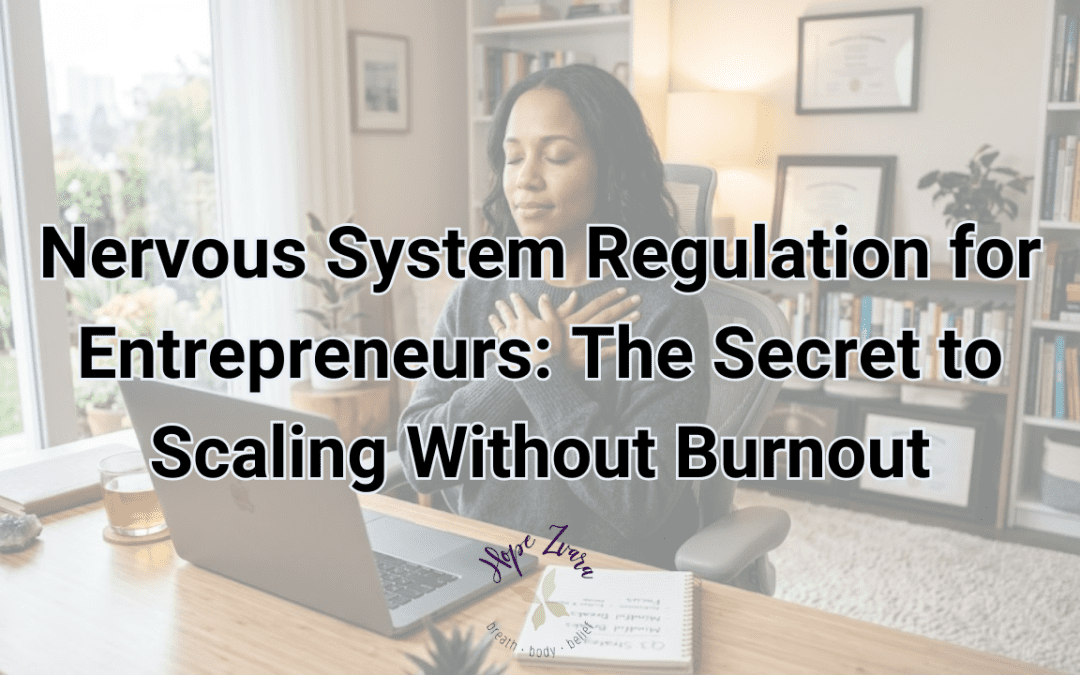
Most entrepreneurs believe scaling challenges are caused by:
- Lack of time
- Lack of strategy
- Lack of productivity
But often, the real issue is something much deeper:
Your nervous system.
Because no matter how smart, ambitious, or capable you are, you cannot sustainably grow a business from a constantly dysregulated state.
This is why nervous system regulation for entrepreneurs has become one of the most important conversations in modern leadership.
Your nervous system influences:
- Decision-making
- Emotional resilience
- Creativity
- Focus
- Capacity for growth
And whether you realize it or not, it is impacting your business every single day.
What Is Nervous System Regulation?
Your nervous system is your body’s internal communication system.
It determines how you respond to:
- Stress
- Pressure
- Uncertainty
- Challenges
When regulated, you feel:
- Grounded
- Clear-headed
- Focused
- Emotionally balanced
When dysregulated, you may experience:
- Anxiety
- Overwhelm
- Brain fog
- Reactivity
- Exhaustion
For entrepreneurs, this matters deeply because scaling a business naturally creates stress and uncertainty.
Without regulation, growth can quickly feel overwhelming.
Why Entrepreneurs Struggle With Nervous System Dysregulation
Entrepreneurship constantly asks your body to handle:
- Risk
- Visibility
- Financial pressure
- Decision fatigue
- Emotional responsibility
And many entrepreneurs unknowingly stay in chronic survival mode.
This often looks like:
- Constant multitasking
- Overworking
- Difficulty resting
- Feeling “on” all the time
- Trouble disconnecting from work
The problem is, your body was never designed to operate under continuous stress.
Your Body Impacts Your Leadership
Most leadership advice focuses on mindset.
But leadership is also physical.
When your nervous system is overwhelmed:
- Communication becomes reactive
- Patience decreases
- Creativity narrows
- Problem-solving feels harder
You may start:
- Snapping at your team
- Avoiding decisions
- Procrastinating important tasks
- Feeling emotionally disconnected from your business
This isn’t a sign you’re failing.
It’s a sign your nervous system needs support.
Scaling Requires Capacity, Not Just Strategy
Many entrepreneurs think they need:
- Better systems
- More discipline
- More motivation
But scaling often requires something else first:
More internal capacity.
Because growth naturally creates:
- More visibility
- More responsibility
- More complexity
If your nervous system cannot safely hold that expansion, burnout often follows.
This is why nervous system regulation for entrepreneurs is essential for sustainable success.
Signs Your Nervous System May Be Overloaded
Entrepreneurs often normalize dysregulation because high stress becomes familiar.
Some common signs include:
- Feeling constantly overwhelmed
- Trouble sleeping
- Emotional exhaustion
- Difficulty concentrating
- Feeling disconnected from joy or creativity
- Overreacting to small problems
- Constant urgency even during rest
These are not just “part of being an entrepreneur.”
They are signals from your body asking for support.
Why Hustle Culture Keeps Entrepreneurs Dysregulated
For years, entrepreneurs were taught that success required:
- Constant grinding
- Sacrificing rest
- Pushing through exhaustion
But hustle culture teaches people to override their bodies instead of listening to them.
Eventually, this creates:
- Chronic stress
- Burnout
- Emotional disconnection
- Health issues
True sustainable leadership requires regulation, not constant pressure.
How to Regulate Your Nervous System While Scaling
The goal is not to eliminate stress completely.
The goal is to increase your ability to move through stress without remaining stuck in survival mode.
Here are some powerful ways to support nervous system regulation.
1. Slow Down Before You Burn Out
Most entrepreneurs wait until they crash before resting.
But regulation requires proactive recovery.
This means:
- Taking intentional pauses
- Creating spaciousness in your schedule
- Allowing time for mental recovery
Rest is not weakness.
It’s nervous system maintenance.
2. Prioritize Movement Daily
Stress lives in the body.
Movement helps release stored tension and regulate emotional energy.
Simple practices like:
- Walking
- Stretching
- Yoga
- Breathwork
Can dramatically shift how your body processes stress.
Movement reconnects you to yourself.
3. Reduce Constant Stimulation
Many entrepreneurs are overstimulated all day long.
Notifications.
Emails.
Social media.
Meetings.
Your nervous system needs moments of quiet to reset.
Creating intentional stillness improves clarity and emotional balance.
4. Learn to Recognize Survival Mode
Awareness is powerful.
Start noticing when your body feels:
- Tight
- Rushed
- Hyper-alert
- Emotionally reactive
These are signs you may be operating from survival instead of alignment.
Awareness allows you to respond differently.
5. Build Emotional Safety Within Yourself
Entrepreneurs often look externally for stability.
But nervous system regulation begins internally.
Practices like:
- Journaling
- Meditation
- Breathwork
- Self-reflection
Help create a sense of emotional safety that supports sustainable leadership.
Intuition Becomes Stronger When You’re Regulated
When your nervous system is overwhelmed, intuition becomes harder to hear.
Fear and urgency get louder.
But regulation creates clarity.
It allows entrepreneurs to:
- Make grounded decisions
- Discern what is aligned
- Trust themselves more deeply
This is why nervous system regulation and intuitive leadership are deeply connected.
Sustainable Success Requires Regulation
The entrepreneurs who sustain long-term success are not always the ones working the hardest.
They are often the ones who:
- Know how to regulate stress
- Protect their energy
- Stay connected to themselves
Because sustainable business growth is not built through chronic survival mode.
It’s built through resilience, awareness, and regulation.
Final Thoughts
Your nervous system is influencing your business more than you think.
It impacts:
- How you lead
- How you communicate
- How you grow
- How you experience success
Nervous system regulation for entrepreneurs is not a luxury, it’s a necessity for sustainable scaling and aligned leadership.
Because when your body feels safe, your mind becomes clearer.
And when you lead from clarity instead of survival, everything changes.
You May Also Like
1. Want to Start the New Year Grounded and Purposeful?
Explore Daily Gratitude Rituals That Boost Focus and Flow for Entrepreneurs
External Resource: https://www.psychologytoday.com/us/basics/mindfulness
2. Need Help Reconnecting With Your Inner Guidance?
Trust Your Gut: How Following Your Intuition Leads to Better Decisions & Less Stress
External Resource: https://livealifeyoulove.com/inner-wisdom/
3. Feeling Drained After a Long Year?
The Power of Gratitude: How Thankfulness Transforms Your Mind and Business
External Resource: https://www.mayoclinic.org/healthy-lifestyle
4. Looking to Bring Calm Into Your Leadership Style?
The Hidden Power of Breathwork for Entrepreneurs
External Resource: https://www.health.harvard.edu/mind-and-mood/relaxation-techniques-breath-control-helps-quell-errant-stress-response

by Hope Zvara | May 12, 2026 | Core Functional Fitness, Lifestyle, Self-Care, Working With Hope
How Vibration Plates Support Bone Density, Joint Health & Balance for Women Over 40
Let’s talk about the fears that keep many women up at night as they age: brittle bones that fracture easily, stiff joints that limit movement, and the terrifying possibility of a fall that changes everything.
These aren’t just abstract worries, they’re real health concerns that affect millions of women over 40. Osteoporosis, arthritis, and falls are among the leading causes of disability and loss of independence in midlife and beyond.
Here’s the empowering news: you have far more control over your bone density, joint health, and balance than you might think. And one of the most effective, low-impact tools available is something that takes just 10 minutes a day, a vibration plate.
In this guide, we’ll explore exactly how vibration plates support bone strength, reduce stiffness, improve mobility, and dramatically reduce your fall risk as you age.
The Bone Density Crisis for Women Over 40
Let’s start with some sobering statistics:
- Women can lose up to 20% of their bone density in the 5-7 years following menopause
- 1 in 2 women over 50 will experience an osteoporosis-related fracture
- Hip fractures carry a 20% mortality rate within one year
- After menopause, bone loss accelerates to 1-2% per year without intervention
Why Menopause Destroys Bone Density
Estrogen is your bones’ best friend. It helps regulate osteoblasts (cells that BUILD bone) and osteoclasts (cells that BREAK DOWN bone). When estrogen plummets during menopause, this balance tips dramatically toward bone loss.
Traditional recommendations include:
- Weight-bearing exercise (walking, jogging)
- Resistance training (lifting weights)
- High-impact activities (jumping)
The problem? Many women over 40 already have joint pain, previous injuries, or conditions that make high-impact exercise uncomfortable or even harmful.
This is where vibration plates offer a revolutionary alternative.
How Vibration Plates Build Bone Density
Research from the Journal of Bone and Mineral Research demonstrates that whole body vibration training can help maintain and even improve bone mineral density in postmenopausal women, comparable to traditional weight-bearing exercise, but without the joint stress.
The Mechanism: Mechanical Loading
Your bones respond to mechanical stress by becoming stronger (Wolff’s Law). When you stand on a vibration plate:
- Rapid oscillations create mechanical loading on your skeleton
- This stimulates osteoblasts (bone-building cells)
- Increases bone mineral deposition
- Improves bone architecture and density
- All without pounding your joints
Each vibration sends a gentle “signal” to your bones: “We need to be stronger!” When done consistently, your bones respond by becoming denser.
The Research
A 2016 study in Osteoporosis International found that postmenopausal women who used vibration plates 3 times weekly for 6 months showed:
- Significant improvements in lumbar spine bone density
- Increased femoral neck (hip) bone strength
- Better results than the control group doing conventional exercise
Another study published in Bone showed that vibration therapy was particularly effective for women who couldn’t tolerate high-impact exercise.
Joint Health: Reducing Stiffness & Improving Mobility
If you wake up stiff, struggle to bend down, or feel like the Tin Man before your body “warms up, ” you’re experiencing the normal but frustrating reality of aging joints.
What Causes Morning Stiffness After 40?
- Reduced synovial fluid production: This is your joint’s natural lubricant (think WD-40 for your body)
- Fascia tightening: The connective tissue wrapping your muscles becomes less elastic
- Decreased circulation: Less blood flow means less oxygen and nutrients to joint tissues
- Mild inflammation: Low-grade inflammation accumulates in joint spaces
- Cartilage wear: Years of use naturally thin cartilage
How Vibration Plates Improve Joint Health
📺 WATCH: Reduce Stiffness & Improve Mobility
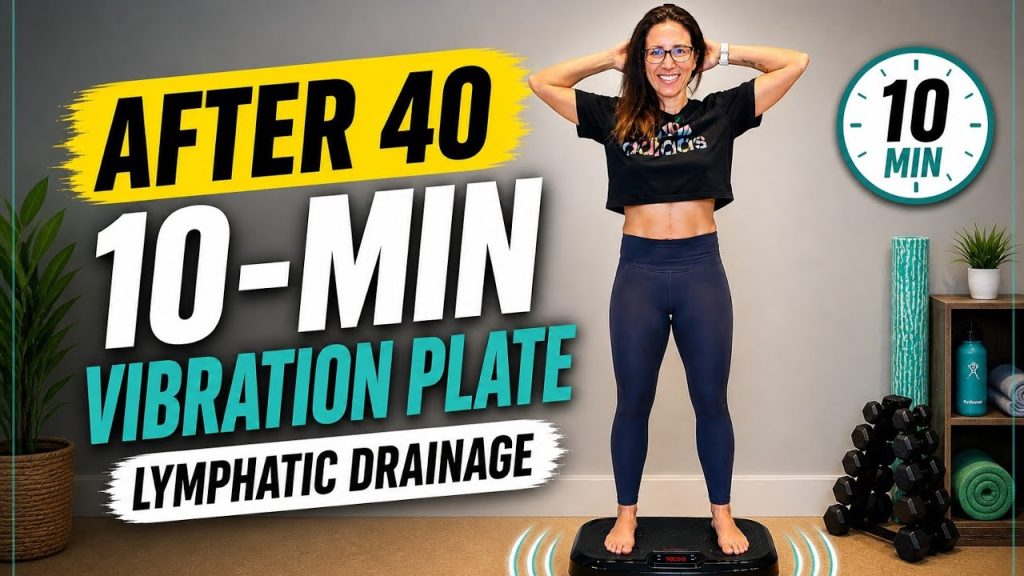
Click here to watch: https://youtu.be/bMVfBPmZKjs
This 10-minute routine helps reduce stiffness, improve joint mobility, and support circulation through simple low-impact movement perfect for women over 40.
When you use a vibration plate, several joint-beneficial things happen simultaneously:
✅ Increased synovial fluid production: The gentle oscillations stimulate your joints to produce more lubricating fluid
✅ Improved circulation: Enhanced blood flow delivers oxygen and nutrients while removing inflammatory waste products
✅ Fascia release: Vibrations help break up adhesions in connective tissue, improving flexibility
✅ Muscle warming: Rapid contractions increase tissue temperature, making movement easier
✅ Reduced inflammation: Better circulation and lymphatic drainage remove inflammatory compounds
✅ Enhanced range of motion: All of the above combine to improve how far and easily your joints can move
Morning Mobility Routine: Your Stiffness Solution
The best time to address stiffness is first thing in the morning, before it sets the tone for your entire day.
The 10-Minute Morning Protocol:
Minutes 1-3: Open lymphatic drainage points and gentle breathing
Minutes 4-6: Simple standing with gentle arm movements
Minutes 7-8: Torso twists and side bends
Minutes 9-10: Gentle squats and calf raises
This routine literally “wakes up” your body, gets fluid moving, warms tissues, and sets you up for a pain-free, mobile day.
📺 WATCH: Morning Mobility Routine
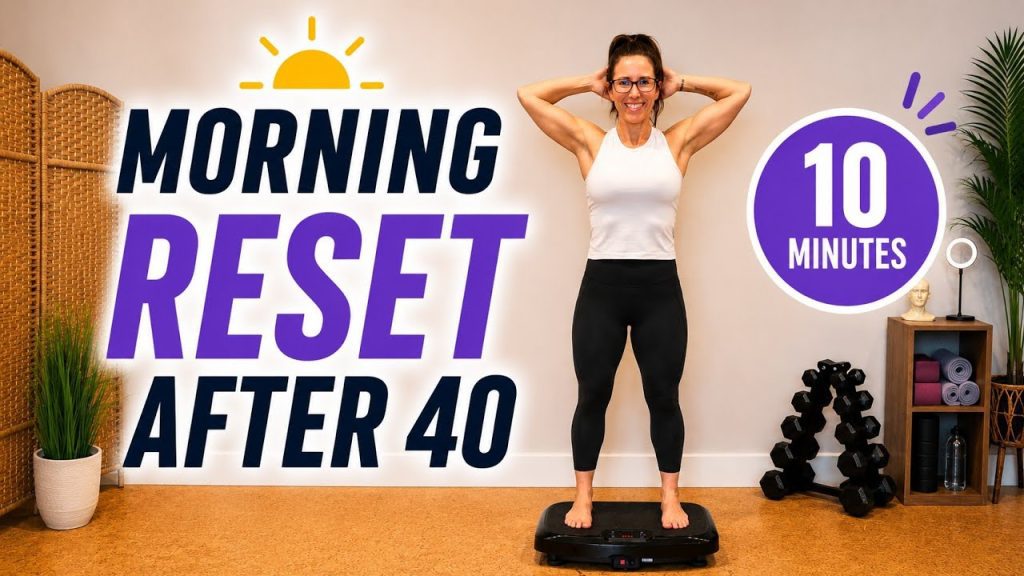
Click here to watch: https://youtu.be/Aqu1dsh3Zf0
Wake up your body and start your day feeling lighter, more mobile, and energized. This morning routine combines vibration plate exercises with lymphatic drainage movements to reduce bloating, improve circulation, and support mobility.
Balance & Fall Prevention: Why This Matters More Than You Think
Here’s a statistic that should get your attention: falls are the leading cause of injury-related death in women over 65.
Even non-fatal falls can be life-changing:
- Hip fractures often lead to loss of independence
- Fear of falling causes many women to limit activity (which ironically increases fall risk)
- Recovery from fall-related injuries takes much longer after 40
Why Balance Declines After 40
- Proprioception decreases: Your body’s sense of where it is in space diminishes
- Reaction time slows: Neural pathways aren’t as fast
- Muscle strength declines: Particularly the small stabilizer muscles
- Vision changes: Depth perception and peripheral vision worsen
- Inner ear function: Vestibular system becomes less efficient
- Medications: Many common medications affect balance
The Vibration Plate Balance Solution
Research published in Age and Ageing found that vibration plate training reduced fall risk by up to 30% in older adults.
Here’s why vibration plates are so effective for balance:
✅ Activates stabilizer muscles: The small, deep muscles that keep you upright fire constantly to counteract vibrations
✅ Improves proprioception: Your nervous system gets better at sensing body position
✅ Strengthens ankles: Ankle stability is critical for preventing falls
✅ Enhances neuromuscular coordination: Your brain and muscles communicate more efficiently
✅ Builds confidence: As balance improves, fear of falling decreases
Even simple standing on a vibration plate challenges your balance system in ways that flat-surface exercises cannot. It’s like balance training on “hard mode”, but safely, with something to hold onto if needed.
📺 WATCH: Balance & Stability Workout

Click Here to watch: https://www.youtube.com/watch?v=zOi3XEsi-K8
This routine combines gentle balance and stability exercises on the vibration plate to help improve coordination, activate stabilizing muscles, and reduce fall risk while supporting lymphatic drainage.
Optimal Settings for Bone & Joint Health
For Bone Density:
- Frequency: 20-35 Hz (medium to high)
- Amplitude: Medium to high
- Duration: 10-15 minutes
- Frequency of use: 3-5 times weekly
- Positions: Weight-bearing (standing, squatting, lunges)
For Joint Mobility & Stiffness:
- Frequency: 10-20 Hz (low to medium)
- Amplitude: Low to medium
- Duration: 10-15 minutes
- Frequency of use: Daily is ideal, especially mornings
- Positions: Varied, including seated if needed
For Balance Training:
- Frequency: 15-25 Hz (medium)
- Amplitude: Medium
- Duration: 10-15 minutes
- Frequency of use: 4-5 times weekly
- Positions: Standing on one leg, narrow stance, eyes closed (advanced)
Specific Joint Concerns
Knee Arthritis
Vibration plates can help strengthen the muscles around your knees without the impact of walking or stairs. Stronger quads and hamstrings take pressure off knee joints.
Best exercises: Gentle squats, seated leg extensions, standing with soft knees
Hip Stiffness
Hip mobility is crucial for functional movement. Vibration enhances hip flexor release and strengthens hip stabilizers.
Best exercises: Standing hip circles, gentle lunges, side-to-side weight shifts
Lower Back Pain
Core strengthening on the vibration plate helps support your spine without crunches or heavy lifting.
Best exercises: Standing core engagement, gentle pelvic tilts, torso rotations
Shoulder Tension
Upper body movement on the vibration plate releases fascial restrictions and improves shoulder mobility.
Best exercises: Arm circles, shoulder rolls, gentle pressing movements
The Fascia Connection
Fascia is the connective tissue that wraps every muscle, organ, and structure in your body. When it becomes tight or restricted (through aging, sedentary lifestyle, or dehydration), it:
- Limits range of motion
- Creates pain and stiffness
- Restricts lymphatic flow
- Reduces circulation
Vibration plates help release fascial restrictions through:
- Increased tissue temperature
- Improved hydration of tissues
- Breaking up adhesions
- Enhanced elasticity
Many women combine foam rolling with vibration plate work for even better fascia release and mobility gains.
Building a Bone & Joint Support Practice
Weekly Schedule Example:
Monday: Morning mobility routine (10 min)
Tuesday: Balance & stability workout (10 min)
Wednesday: Bone-building routine with higher frequency (12 min)
Thursday: Gentle joint mobility and fascia release (10 min)
Friday: Balance & stability workout (10 min)
Saturday: Bone-building routine (12 min)
Sunday: Gentle recovery or rest
Progression Timeline:
Weeks 1-4: Focus on consistency and proper form
Weeks 5-8: Gradually increase intensity and challenge balance
Weeks 9-12: Add single-leg exercises and closed-eye balance work
Month 4+: Maintain routine, track measurable improvements
Complementary Practices for Maximum Benefit
Nutrition for Bones & Joints:
- Calcium: 1, 200 mg daily (from food + supplements if needed)
- Vitamin D: 1, 000-2, 000 IU daily (get levels tested)
- Vitamin K2: Helps direct calcium to bones
- Magnesium: Critical for bone structure
- Omega-3 fatty acids: Reduce joint inflammation
- Collagen peptides: Support cartilage and connective tissue
Lifestyle Factors:
- Sunlight exposure: 15-20 minutes daily for vitamin D
- Quality sleep: Recovery and repair happen during sleep
- Stress management: Chronic stress accelerates bone loss
- Adequate protein: 0.8-1g per pound of body weight for muscle maintenance
- Hydration: Essential for synovial fluid and fascia health
Safety Considerations
While vibration plates are generally safe, consult your doctor if you have:
- Severe osteoporosis: May need to start very gently
- Recent fractures: Wait until fully healed
- Joint replacements: Usually okay, but get clearance first
- Acute joint inflammation: Wait until inflammation subsides
Never push through sharp pain. Some muscle fatigue is normal; joint pain is not.
Real Women, Real Results
“I was diagnosed with osteopenia at 52. My doctor said I needed weight-bearing exercise, but running hurt my knees. The vibration plate has been perfect, my last bone density scan showed improvement for the first time in years!” , Susan, 55
“I couldn’t touch my toes or get down on the floor to play with my grandkids. After 8 weeks of daily morning vibration plate routines, my flexibility has improved dramatically. I feel 10 years younger.” , Margaret, 58
“I fell twice last year and was terrified it would keep happening. The balance work on the vibration plate has made me so much more stable and confident. I’m hiking again!” , Joyce, 61
Your Bone, Joint & Balance Action Plan
This Week:
- ✅ Try the morning mobility routine 4 times
- ✅ Notice how your joints feel, stiffness, range of motion, pain levels
- ✅ Ensure adequate calcium and vitamin D intake
This Month:
- ✅ Establish 4-5 weekly sessions focused on bone and joint health
- ✅ Add balance challenges gradually
- ✅ Track improvements (Can you reach farther? Stand on one leg longer?)
Long-Term:
- ✅ Make this a non-negotiable daily practice
- ✅ Get bone density tested (baseline and annually)
- ✅ Continue challenging yourself with progressive exercises
- ✅ Celebrate your strength and mobility gains!
Ready to Build Stronger Bones & Better Balance?
Your next steps:
- ✅ Try the morning mobility routine tomorrow
- ✅ Do the balance & stability workout 2x this week
- ✅ Subscribe to Hope Zvara on YouTube for more bone and joint health routines
- ✅ Read Blog 4 to learn about muscle toning and stress relief
- ✅ Schedule your next bone density test
Remember: Your bones respond to consistent mechanical stress. Your joints thrive on regular, gentle movement. Your balance improves with challenge. Give your body what it needs, and it will reward you with strength, stability, and confidence for decades to come.
Subscribe to Hope Zvara on YouTube for:
- Bone-building vibration plate routines
- Joint mobility and flexibility workouts
- Balance and fall prevention exercises
- Functional fitness for women over 40
👉 https://www.youtube.com/@HopeZvara
Disclaimer: This information is for educational purposes only and not medical advice. Always consult your healthcare provider before starting any new exercise program, especially with osteoporosis, recent fractures, joint replacements, or other bone/joint conditions. Get appropriate medical screening and clearance. Individual results may vary.
About Hope Zvara:
Hope Zvara empowers women over 40 with accessible wellness practices focusing on lymphatic health, functional fitness, and healthy aging. Her YouTube channel features guided routines combining vibration plates, yoga, mobility work, and strength training for midlife wellness.
Hopezvara.com/blog
