
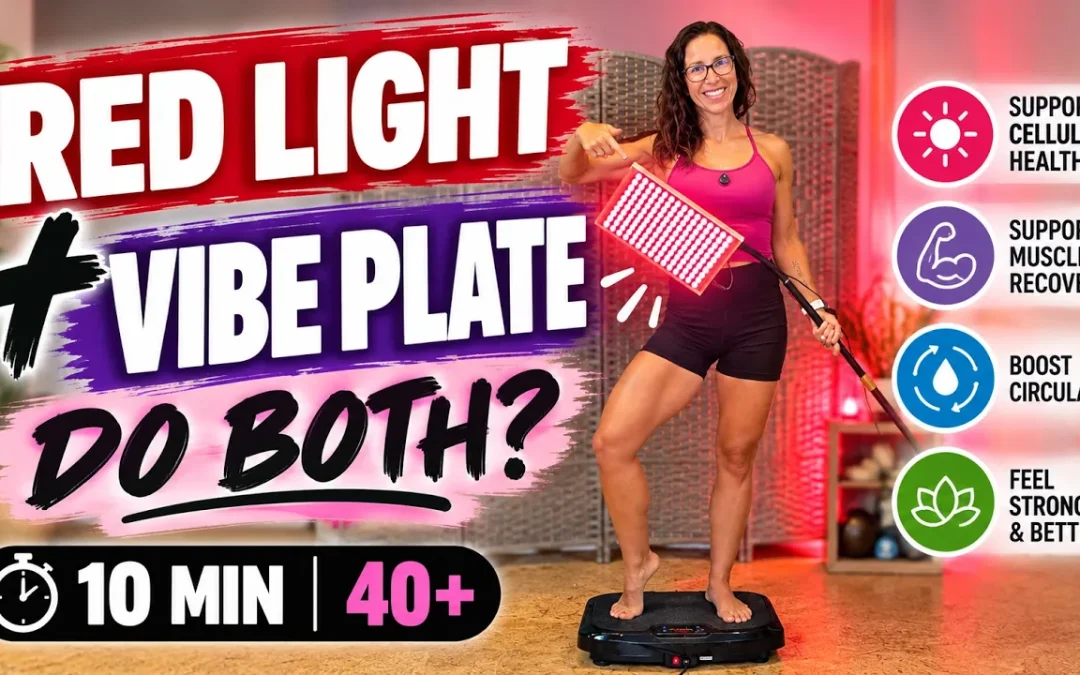
Red Light Therapy + Vibration Plate: Should You Use Them Together?
If you’ve been following me on YouTube lately, you already know I have fallen down the vibration plate rabbit hole.
But here’s the thing about me: I don’t just want to stand on something because someone on the internet told me it’s good for me.
I want to MOVE.
I want to understand how something works. I want to know how I can use it more effectively. And most importantly, I want the things I add to my wellness routine to help me continue doing real life.
Which brings me to something I’ve been experimenting with lately:
Red light therapy and vibration plate exercise together.
These are two very different wellness tools, but that’s actually what makes pairing them interesting.
A vibration plate provides a mechanical stimulus to the body. Red and near-infrared light provide a light-based stimulus to tissues.
So rather than thinking, “Which one is better?” I think the more interesting question is:
Could they complement one another in a well-rounded movement and recovery routine?
Let’s talk about it.
What Does a Vibration Plate Actually Do?
A vibration plate creates rapid mechanical oscillations beneath your body. Your muscles respond to that stimulus with repeated contractions as your body works to stabilize itself.
But—and if you’ve watched any of my videos, you know I’m going to say this—standing on the plate doing absolutely nothing is not the only way to use it.
You can squat.
You can work your calves.
You can perform mobility exercises.
You can incorporate upper-body movements.
You can work on balance, posture and functional strength.
You can even use the plate as part of a lower-intensity movement or recovery day.
Whole-body vibration has been studied for muscle strength, balance and bone health. A 2026 systematic review and meta-analysis involving 1,447 older adults found improvements in bone mineral density at several measured skeletal sites, although benefits weren’t seen at every site studied. DOI
That’s an important distinction.
A vibration plate isn’t magic.
It’s a tool.
And like most fitness tools, what you DO with it matters.
So What About Red Light Therapy?
Red light therapy, also called photobiomodulation, uses specific wavelengths of red and/or near-infrared light.
Unlike the mechanical stimulation of a vibration plate, photobiomodulation interacts with tissue through light. It’s being studied in areas including muscle recovery, soreness, skin health, exercise performance and sleep.
And this is one of those places where I think we need to be careful about wellness hype.
Research is promising in certain applications, but it isn’t a giant YES for every claim you see online.
For example, a recent meta-analysis found evidence that photobiomodulation applied before exercise may reduce muscle soreness and improve performance 24 hours after exercise-induced muscle damage. However, a systematic review specifically examining whole-body photobiomodulation found no demonstrated improvement in exercise performance or fatigue biomarkers, although some studies reported improvements in sleep measures. DOI
Translation?
Interesting tool. Growing research. Not magic.
Which is pretty much how I approach most things in wellness.
Grab Hope’s red light therapy panel lamp: https://amzn.to/4e97rAL
Why Use Red Light Therapy and a Vibration Plate Together?
This is where things get interesting.
The two modalities work differently.
Vibration plate = mechanical stimulation + movement + muscle activation
Red light therapy = photobiomodulation + cellular/tissue-level light exposure
That’s why some wellness facilities and manufacturers have begun combining the two. Airvida Chambers
Now, I want to make something VERY clear.
We don’t currently have strong evidence saying, “Combine red light therapy with a vibration plate and you’ll get X percent better results.”
That’s not where the research is yet.
But because the two tools provide different types of stimulus, I think they can make sense as complementary parts of a larger wellness routine.
And that’s exactly how I use them.
What I REALLY Like About This Combination
It’s efficient.
You know me. I’m a huge believer in finding ways to incorporate movement and wellness into REAL life rather than believing you need another 90-minute routine added to your day.
If I’m already using my red light, why not incorporate intentional movement?
And if I’m already using my vibration plate, why not think about what else might complement what I’m doing?
This is where I want you to move beyond simply standing there.
Depending on your ability and your specific plate, you might incorporate things like:
Squats and squat variations, calf raises, gentle bouncing, weight shifting, mobility exercises, balance work, functional core exercises or upper-body movements.
The goal isn’t to cram 47 wellness hacks into ten minutes.
The goal is to use the tools you have intentionally.
Watch My Red Light + Vibration Plate Routine
This is exactly why I created my newest YouTube workout.
Instead of me simply telling you about red light therapy and vibration plates, I want to SHOW you one way I put them together.
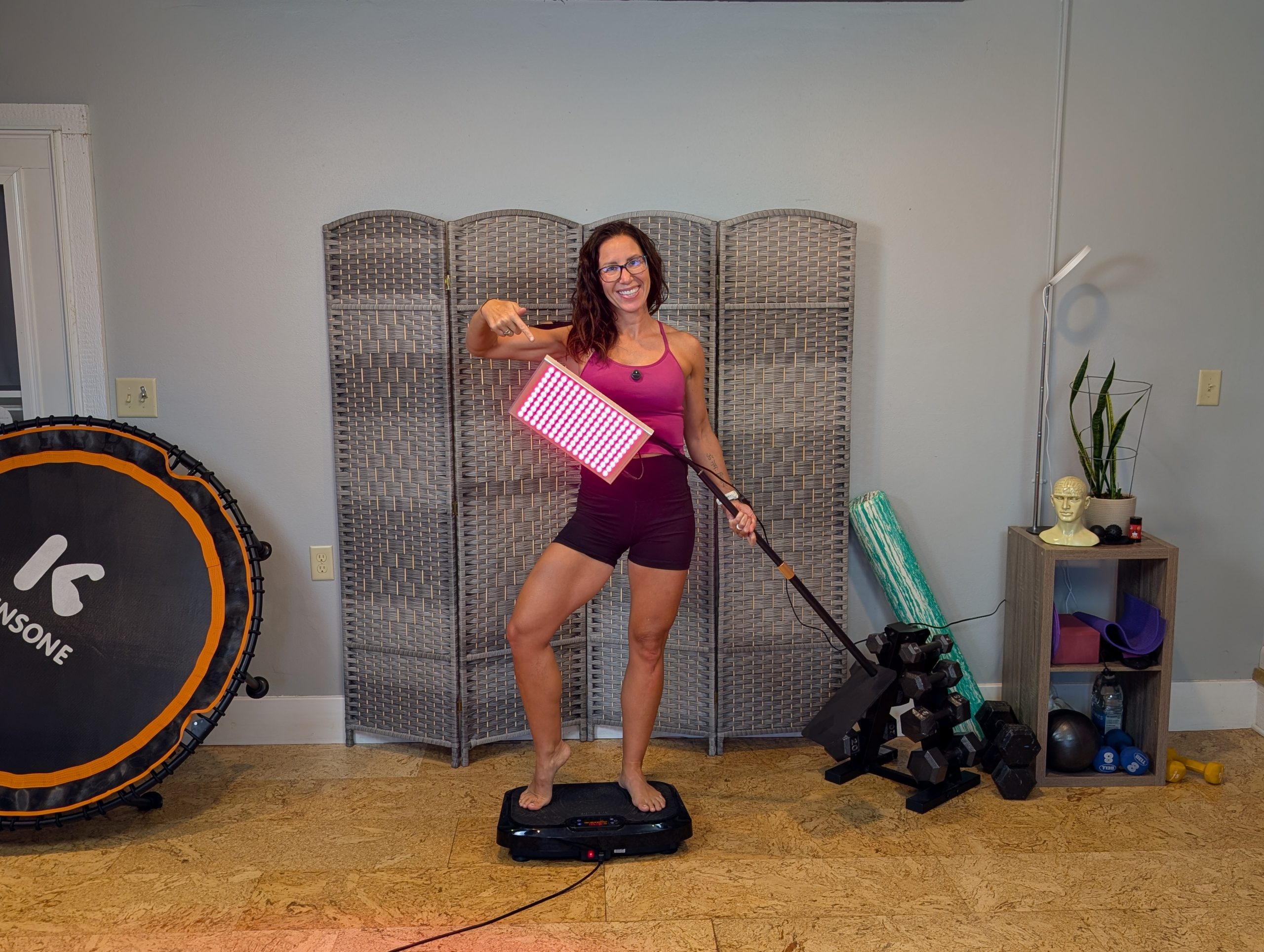
Watch my Red Light + Vibration Plate workout on YouTube
And if you’re new to my channel, this isn’t your typical “stand on the vibration plate for ten minutes and call it a workout” kind of video.
We’re going to MOVE.
Because I want your vibration plate to become something you know how to use rather than another expensive piece of equipment sitting in the corner collecting dust.
Which Should Come First: Red Light or Vibration?
You’ll find different recommendations online.
Some routines use vibration first and red light afterward as part of recovery. Others combine light exposure with movement when the equipment setup allows for it. The Airvida article you shared, for example, suggests vibration followed by red light as one possible routine. Airvida Chambers
Personally, I wouldn’t get overly obsessed with finding the one “perfect” sequence unless you’re following a specific therapeutic protocol.
Consistency matters too.
If combining them makes it easier for you to actually USE both tools, move your body and create a routine you’ll stick with, that’s worth something.
But Hope, Will This Help With Lymphatic Flow?
I know some of you were waiting for this question. 🙂
Movement matters for lymphatic flow because, unlike your cardiovascular system, your lymphatic system doesn’t have a heart-like central pump moving lymph around the body.
Muscle contractions, breathing and body movement all contribute to lymph movement.
That’s one reason I talk so much about actually MOVING on your vibration plate rather than thinking more vibration automatically equals better lymphatic drainage.
And red light shouldn’t be viewed as a replacement for movement, hydration, sleep, nutrition or appropriate medical care.
Think addition, not replacement.
That’s really my philosophy with both of these tools.
More Isn’t Always Better
This is another place where wellness culture gets us into trouble.
If 10 minutes is good, 40 minutes must be AMAZING, right?
Not necessarily.
Different vibration plates operate at different frequencies and amplitudes, and red-light devices vary tremendously in wavelength, irradiance, distance recommendations and treatment times.
Follow the instructions for YOUR equipment.
With vibration plates in particular, your position matters too. Slightly softening the knees rather than locking them can help your lower body manage the vibration more comfortably. The manufacturer guidance for your particular machine should always take priority. Airvida Chambers
And if you have a medical condition, are pregnant, have an implanted medical device, take photosensitizing medications, or aren’t sure whether either modality is appropriate for you, talk with your healthcare professional before using it.
The Bigger Picture
Here’s where I want to leave you.
I love wellness tools.
I love my vibration plate. I’m interested in red light. I love exploring ways we can take better care of ourselves, especially as we get older.
But I don’t want you believing that your health is hiding inside the next machine you buy.
The machine is the tool. YOU are still the one doing the work.
Move your body.
Build muscle.
Eat well.
Drink water.
Sleep.
Get outside.
Manage your stress.
Breathe.
Connect with people.
And then, if something like a vibration plate or red light therapy helps you support those things, fantastic.
Use it.
That’s where I believe red light therapy and vibration plate training can fit beautifully together—not as another miracle wellness hack, but as two tools you can intentionally add to a bigger picture of taking care of yourself.
Because ultimately, I’m not interested in doing something just because it’s trendy.
I’m interested in doing the things that help me continue doing LIFE.
And if you’re ready to try this combination with me, grab your vibration plate, turn on that red light and come move.
Do the Red Light + Vibration Plate workout with me
Hope
This article is for educational purposes and isn’t intended to diagnose, treat, cure or prevent any medical condition.
You May Also Like
Why Intuition Is Your Most Underrated Business Tool – Learn how intuitive leadership improves clarity and decision-making in complex environments.
https://hopezvara.com/why-intuition-is-your-most-underrated-business-tool
https://hbr.org/2022/03/how-to-stop-overthinking-and-start-trusting-your-gut
From Burnout to Breakthrough: Wellness Habits That Actually Stick – Explore how nervous system regulation supports sustainable leadership performance.
https://hopezvara.com/from-burnout-to-breakthrough-wellness-habits-that-actually-stick
https://www.mayoclinic.org/healthy-lifestyle/stress-management/basics/stress-basics/hlv-20049495
The Hidden Power of Breathwork for Entrepreneurs – Discover why breathwork is a foundational tool for regulated leadership.
https://hopezvara.com/the-hidden-power-of-breathwork-for-entrepreneurs
https://www.ncbi.nlm.nih.gov/pmc/articles/PMC6137615/
Creating a Morning Routine That Aligns With Your Purpose – Learn how intentional rituals support heart-centered leadership.
https://hopezvara.com/creating-a-morning-routine-that-aligns-with-your-purpose
https://www.psychologytoday.com/us/basics/habit-fo