by Hope Zvara | Oct 5, 2026 | Inspirational, Simplify Your Life, Working With Hope
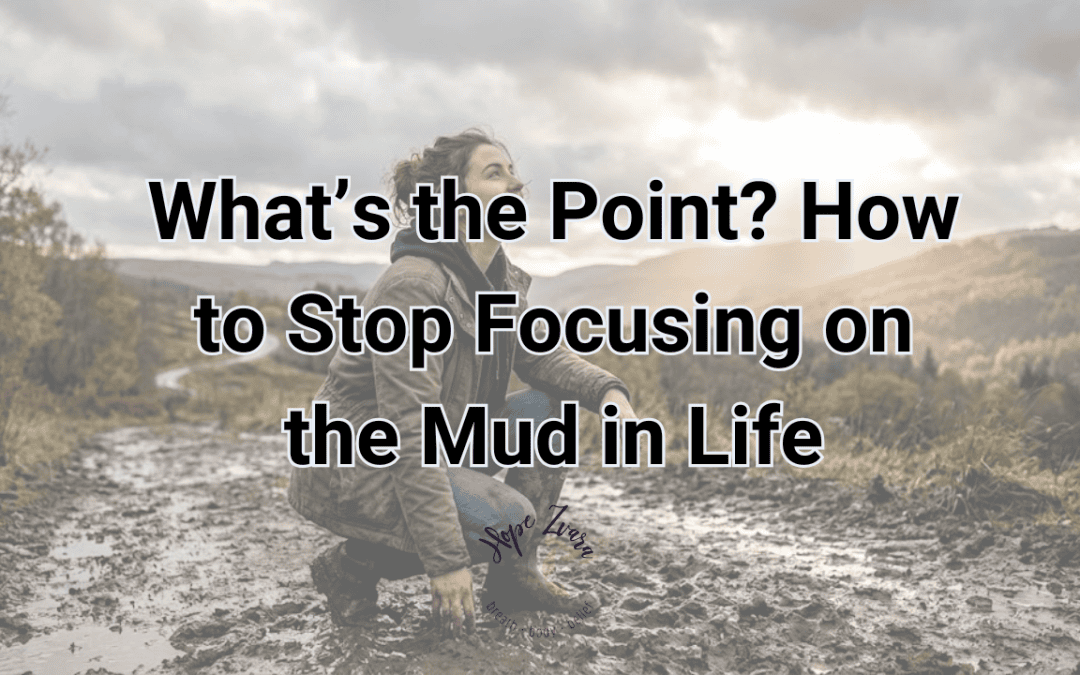
My Brain Really Likes the Mud 😂
Ever wonder what the point of something is?
Why am I working at this job? Why am I still in this relationship? Why did I say yes to that? Why am I still here? Why is my life this way?
I’ve had a lot of curveballs thrown at me in my life, and when I was younger, I would ask, “Why?”
Then I got a bit older and started asking, “What’s the point?”
But here’s what’s funny. I only seemed to ask that question when things weren’t going well. When they weren’t going MY way.
In other words, when life got hard.
Why Do We Only Ask When Things Are Hard?
Why do we rarely ask “what’s the point?” when things are going great?
Why did I marry the love of my life? Why did I get the opportunity? Why did I buy the house? Why am I healthy enough to do the things I love? Why did I get to go on this amazing trip?
Who asks those questions?
No one. 😂
Part of this is actually how our brains work. There’s something called negativity bias, which basically means our brains naturally give more attention to negative experiences than positive ones.
Basically, your brain is really good at spotting the mud.
Sun’s out, it’s 75 degrees, beautiful day…but you step in mud.
What are you thinking about now?
The mud.
I literally just experienced this.
Over the last several weeks, I’ve received dozens of raving comments on my YouTube videos. Women telling me how much the workouts are helping them, how much they love my teaching style, and that they’re coming back for more.
Then ONE person told me my intro was too long.
Guess which comment I kept thinking about?
Yep. That one. 😂
My brain apparently decided the intro lady deserved VIP access to my thoughts.
That’s negativity bias in real life.
Your Brain Will Notice What’s Wrong
You lose 10 pounds but still have 20 to go. Instead of celebrating the TEN FREAKING POUNDS you lost, you’re focused on what’s left.
You overcome obstacle after obstacle and make huge strides in your life, yet because you don’t have exactly what you want RIGHT NOW, somehow none of it feels like enough.
I’m guilty of this.
For a long time, my inner voice was an absolute mess. I grew up in a house where one parent rarely spoke positively about their life or the lives of others, and without realizing it, I took some of that on.
Eventually, it became how I talked to myself.
Smart. But not smart enough.
Pretty. But not pretty enough.
Successful. But not successful enough.
Good. But not good enough.
There was always a “but.”
Maybe the Point Isn’t Gone
And here’s where this whole “what’s the point?” thing gets interesting.
Maybe the point doesn’t disappear when life gets hard.
Maybe we just have a harder time seeing it.
When something isn’t going well, our attention goes there immediately.
What’s wrong?
What’s missing?
Why isn’t this working?
What’s the point?
Meanwhile, 15 other things could be going right, and we’re barely noticing them.
Now, that doesn’t mean you slap a positive affirmation over something painful and pretend everything is sunshine and rainbows.
Listen, I LOVE a good positive quote.
But a positive quote is not a life strategy.
Sorry, Sarah. 😂
Sometimes the job DOES need to change.
Sometimes the relationship DOES need to end.
Sometimes the thing you’ve been pushing toward isn’t right anymore.
And sometimes something really does suck.
The point isn’t to ignore what’s wrong.
It’s to stop allowing what’s wrong to become the only thing you can see.

What Am I Not Seeing?
Maybe instead of immediately asking, “What’s the point?” we ask:
What am I not seeing because I’m so focused on this one thing?
What IS working?
Is this actually bad, or is it just not going how I wanted it to?
Do I need to change something, or do I need to give this more time?
Because sometimes you won’t know the point of something for YEARS.
I’ve had plenty of those.
Things I once prayed would disappear from my life are now experiences I pull from when I teach, write, speak, parent, and help other people.
Would I have volunteered for all of them?
HELL NO.
But here I am.
And maybe that’s something I’ve learned as I’ve gotten older.
I don’t always need to know the point while I’m standing in the middle of it.
While I’m standing in the mud.
Sometimes the point shows up later.
Sometimes I give it a point.
And sometimes something happened, it sucked, I dealt with it, and moved forward.
That’s life too.
Don’t Let One Thing Become Everything
What I don’t want to do anymore is let one wrong thing convince me that everything is wrong.
One crappy comment doesn’t erase dozens of great ones.
One business problem doesn’t mean the business is failing.
One hard season doesn’t mean you have a hard life.
One last place doesn’t mean you will never have a first.
And one muddy step doesn’t mean the entire freaking day is ruined.
My brain will probably always notice the mud.
Fine.
I just don’t have to build a house there.
The mud is real.
But so is the sunshine.
And I’m getting a little better at noticing both.
Hope
PS: It’s just a little mud.
by Hope Zvara | Sep 30, 2026 | Simplify Your Life, Wellness Wednesday, Working With Hope
There is something about watching someone else’s success that can make you question your own.
You see the launch.
The book.
The podcast.
The new offer.
The six-figure month.
The beautiful website.
The sold-out event.
The announcement that makes you think:
“Wow. They figured it out.”
And then you look at your own business.
Maybe yours feels slower.
Maybe you’re still building.
Maybe you’ve been doing the work for months, or even years, and you’re wondering why it hasn’t all come together yet.
I’ve been there.
And honestly, I think a lot more people are there than we realize.
We just don’t talk about the slow part very often.
We talk about the breakthrough.
We talk about the overnight success.
We talk about the moment everything finally clicked.
But rarely do we talk about all the ordinary days that came before it.
The days when nothing seemed to be happening.
The days when you wondered if your efforts were actually working.
The days when you had to keep showing up without any guarantee that the thing you were building would become what you hoped it would become.
That is the slow burn.
And sometimes, the slow burn is where the real work happens.
This is something I’ve had to remind myself more than once.
Progress doesn’t always look exciting.
Sometimes progress looks like answering the same emails.
Refining an offer.
Having another conversation.
Learning something you wish you had known six months ago.
Changing direction.
Trying something that doesn’t work.
Starting again.
Getting clearer about what you don’t want.
Saying no to something that looks good on paper but doesn’t feel right anymore.
None of those things necessarily make a great social media post.
But they matter.
Business growth isn’t always a straight line upward.
Sometimes it looks like you’re standing still when you’re actually building something underneath the surface.
We live in a world that loves speed.
Fast growth.
Fast launches.
Fast content.
Fast money.
Fast transformation.
Even the word “overnight” gets attached to success stories that took years to build.
And when you constantly see other people’s highlights, it’s easy to believe you’re behind.
But what if you’re not behind?
What if you’re simply in a part of the process that doesn’t have a flashy name yet?
What if the thing you’re building needs time?
Not because you’re doing something wrong.
But because you’re becoming the person who can actually hold what you’re asking for.
That part matters.
I can look back at different seasons of my own life and see that there were things I wanted before I was actually ready to hold them.
I wanted the opportunity.
But I hadn’t developed the capacity.
I wanted the growth.
But I hadn’t learned the lesson.
I wanted the next level.
But I was still trying to operate from the version of me that built the previous one.
That can be uncomfortable.
Because sometimes the delay isn’t about the business.
Sometimes we are the thing that is still developing.
Our confidence.
Our boundaries.
Our ability to make decisions.
Our communication.
Our relationship with money.
Our ability to rest.
Our ability to trust ourselves.
Our willingness to be visible.
Our capacity to lead.
These things take time.
When everything is moving quickly, it’s easy to believe that momentum is the same thing as alignment.
It isn’t always.
A busy calendar doesn’t automatically mean you’re building the right business.
More clients don’t automatically mean you’re building a sustainable business.
More revenue doesn’t automatically mean you’re happy.
More visibility doesn’t automatically mean you’re connected to yourself.
Sometimes a slower season gives you the space to ask questions you wouldn’t ask if everything were moving at full speed.
Do I actually want this?
Is this still the direction I want to go?
What am I doing because it feels aligned, and what am I doing because I’m afraid to stop?
What would I build if I stopped trying to prove something?
Those are powerful questions.
And sometimes they only become available when things slow down.
This is a hard one for entrepreneurs.
We want to do all the things.
Create the course.
Write the book.
Launch the podcast.
Build the community.
Grow the audience.
Create the new offer.
Fix the website.
Start the email list.
Be consistent on social media.
And somehow still have a life.
I’ve learned that just because I can do something doesn’t mean I need to do it right now.
There is a difference between possibility and priority.
Your business can have ten possible directions.
You only have so much energy.
So the question becomes:
What actually matters in this season?
Not forever.
Just now.
We often talk about strategy when we talk about business growth.
What is the funnel?
What’s the offer?
What’s the marketing plan?
What’s the launch strategy?
And yes, those things matter.
But you are the person carrying out the strategy.
If you’re constantly overwhelmed, rushing, second-guessing yourself, or operating from fear, that affects the way you lead.
Your body is part of your business experience.
That doesn’t mean every business challenge is a nervous system issue.
It means sustainable leadership requires us to pay attention to how we’re functioning while we’re building.
Sometimes the most productive thing you can do is step away from the computer.
Take a walk.
Breathe.
Eat something.
Sleep.
Talk to someone you trust.
Let your brain have a little space.
Then come back.
I want to be careful here.
When I say success can take time, I don’t mean sit back and wait.
There is a difference between trusting the process and avoiding action.
The slow burn still requires you to show up.
You still have to make the offer.
Have the conversation.
Send the email.
Create the thing.
Ask the question.
Learn the skill.
Make the uncomfortable decision.
Keep moving.
But you don’t have to demand that every action produce an immediate result.
You can take action without constantly checking whether it has “worked” yet.
That’s where patience comes in.
Think about planting something.
You put the seed in the ground.
You water it.
You give it sunlight.
And then…
Nothing.
At least, nothing you can see.
If you dug the seed up every day to check whether it was growing, you’d interrupt the very process you’re hoping for.
Business can feel like that.
You create something.
You share something.
You help someone.
You make a connection.
You have a conversation.
And you may never know immediately what that interaction becomes.
That doesn’t mean it didn’t matter.
Some things need time.
Some relationships need time.
Some ideas need time.
And sometimes you need time.
This might be one of the biggest traps in entrepreneurship.
You see someone who has been doing something for ten years.
You have been doing it for two.
But you compare your revenue.
Your audience.
Your confidence.
Your visibility.
Your team.
Your opportunities.
That’s not a fair comparison.
You don’t know what their early years looked like.
You don’t know how many things they tried.
You don’t know what they invested.
You don’t know what failed.
You don’t know what support they had.
You don’t know what they sacrificed.
You’re seeing the visible part.
Not the whole story.
So instead of asking:
“Why am I not where they are?”
Try asking:
“What is my next right step?”
That question brings you back to your own life.
There is something valuable about having to stay with something.
You learn.
You adapt.
You develop resilience.
You discover what matters.
You become more discerning.
You learn which opportunities are actually worth pursuing.
You learn how to recover from disappointment.
You learn that one bad month doesn’t define your business.
You learn that one great month doesn’t define it either.
And eventually, you start building from a deeper place.
Not just:
“How can I grow?”
But:
“How do I want to grow?”
That is a very different question.
Sometimes we imagine success as a giant moment.
A huge launch.
A massive breakthrough.
A dramatic before-and-after.
But sustainable success can be much quieter.
It can look like having enough income without constantly being overwhelmed.
It can look like working with clients you genuinely enjoy.
It can look like having boundaries.
It can look like taking a Friday afternoon off.
It can look like having space to think.
It can look like being able to take care of your health while still running your business.
It can look like making decisions without needing everyone else to validate them.
It can look like building something that actually fits your life.
That may not look impressive from the outside.
But it can feel very different on the inside.
This one matters deeply to me.
I don’t believe your success should require you to constantly abandon yourself.
You shouldn’t have to sacrifice every ounce of energy to prove that you’re serious.
You shouldn’t have to live in permanent urgency.
You shouldn’t have to turn exhaustion into a badge of honor.
There will absolutely be seasons where business asks more from you.
That’s real.
But if every season requires more, more, more, eventually there isn’t much left.
The goal isn’t to avoid hard work.
The goal is to create a relationship with work that you can actually sustain.
Maybe you’re in a slow season right now.
Maybe you’re wondering why the next thing hasn’t happened.
Maybe you’ve been doing all the “right” things and still feel like you’re waiting.
Before you decide that you’re failing, ask yourself:
What is this season teaching me?
Maybe it’s patience.
Maybe it’s boundaries.
Maybe it’s discernment.
Maybe it’s confidence.
Maybe it’s how to rest.
Maybe it’s how to trust your own decisions.
Maybe it’s showing you that the thing you thought you wanted isn’t actually what you want anymore.
Maybe the slower pace is giving you time to build something more honest.
You don’t have to force an answer.
Just get curious.
There isn’t one timeline for success.
There isn’t one business model that works for everyone.
There isn’t one definition of “making it.”
And there certainly isn’t one timeline that you have to follow.
Maybe your business grows quickly.
Maybe it grows slowly.
Maybe you have several seasons of growth and several seasons of rebuilding.
Maybe you change directions.
Maybe you surprise yourself.
That’s okay.
Your business is allowed to evolve.
So are you.
This is probably the part I most want you to remember.
Don’t become so focused on the future version of your life that you miss the life you’re living right now.
Yes, build the business.
Yes, pursue the dream.
Yes, take the next step.
But eat the meal.
Take the walk.
Call the person you love.
Go outside.
Laugh.
Rest.
Celebrate the small win.
Be where your feet are.
Because there is no guarantee that the future version of success will somehow make all of today’s moments more valuable.
They are already valuable.
Maybe your business isn’t moving as quickly as you thought it would.
Maybe that’s frustrating.
Maybe there are days when you wonder if you should be further along.
I understand.
But I also want you to remember this:
Slow doesn’t automatically mean wrong.
Sometimes the slow burn is where you learn how to build something that doesn’t require you to abandon yourself to maintain it.
Sometimes the slow season is where your roots grow.
Sometimes the thing you’re waiting for is also waiting for you to become ready to receive it.
And sometimes, the next chapter doesn’t need you to work harder.
It needs you to keep showing up with intention.
So keep going.
Keep learning.
Keep listening.
Keep making the next right decision.
But don’t rush so hard toward the future that you forget to notice who you’re becoming along the way.
Your success doesn’t have to happen overnight to be real.
Some of the strongest things are built slowly.
And maybe your business is one of them.
Learn how intuitive leadership can support clarity and decision-making when business decisions become complex.
https://hopezvara.com/why-intuition-is-your-most-underrated-business-tool
External Resource: Harvard Business Review: How to Stop Overthinking and Start Trusting Your Gut
https://hbr.org/2022/03/how-to-stop-overthinking-and-start-trusting-your-gut
Explore how sustainable wellness habits and nervous system regulation can support healthier leadership and business growth.
https://hopezvara.com/from-burnout-to-breakthrough-wellness-habits-that-actually-stick
External Resource: Mayo Clinic: Stress Basics
https://www.mayoclinic.org/healthy-lifestyle/stress-management/basics/stress-basics/hlv-20049495
Discover why breathwork can become a simple tool for creating more space, awareness, and regulation during the entrepreneurial journey.
https://hopezvara.com/the-hidden-power-of-breathwork-for-entrepreneurs
External Resource: National Institutes of Health: Breathing Practices and Health
https://www.ncbi.nlm.nih.gov/pmc/articles/PMC6137615/
Learn how intentional rituals and consistent habits can help create more clarity and intention in your personal and professional life.
https://hopezvara.com/creating-a-morning-routine-that-aligns-with-your-purpose
External Resource: Psychology Today: Habit Formation
https://www.psychologytoday.com/us/basics/habit-formation

by Hope Zvara | Sep 21, 2026 | Inspirational, Simplify Your Life, Working With Hope
I recently went to Mexico with my husband of 20 years.
Outside of work trips, we haven’t gone on a vacation alone since our honeymoon.
So I guess you could say it was LONG overdue.
And as usually happens when I step away from my normal environment, I came home with a lot of thoughts floating around in my head.
There’s something about getting out of your routine that gives you space to look at your life a little differently.
You notice things.
You question things.
You hear thoughts that may have been buried underneath the noise of everyday life.
One phrase I keep coming back to lately is:
“Make the next right decision.”
It’s definitely up for interpretation, but it has become a pretty powerful mantra for me.
Especially right now.
Because I’m raising teenagers.
And I’m watching them enter that strange stage of life where everyone suddenly starts asking:
“What are you going to do?”
What are you going to do after high school?
Where are you going to go?
What are you going to study?
What do you want to be?
Where are you going to live?
What are you going to do with your LIFE?
Holy crap.
You’re 18 years old, and suddenly it feels like you’re being asked to make decisions that will determine the next 60 years of your existence.
No wonder kids freeze.
But really, don’t we adults do the exact same thing?
We Want to Know the Whole Plan
Should I stay in this job?
Should I start the business?
Should I keep pursuing this project?
Should I change careers?
Should I keep pushing?
Should I finally let something go?
What if I choose wrong?
What if I regret it?
What if I waste time?
What if I fail?
Sometimes the fear of making the wrong decision becomes so overwhelming that we make no decision at all.
And that’s where I’ve been thinking about something that sounds simple but can be incredibly powerful:
Not making a decision is still a decision.
You are deciding to stay where you are.
You are deciding not to apply.
You are deciding not to make the phone call.
You are deciding to give it more time.
You are deciding to wait.
And sometimes, waiting absolutely is the next right decision.
I’ve written about that before.
There are seasons where I believe God is asking us to be patient, stop forcing something, and allow it to unfold.
But there are also times when we’re calling something “waiting” when really we’re just scared to make a decision.
So maybe the better question isn’t simply:
“Should I make a decision?”
Maybe it’s:
“Is NOT making a decision the next right decision?”
Oof.
Because that changes things a little, doesn’t it?
When You Feel Frozen
My husband and I have both had periods in our lives where we’ve felt frozen.
Frozen in a job.
Frozen in a career path.
Frozen in a business.
Frozen in a project.
Sometimes the future felt so blurry that we couldn’t clearly see which direction to go.
And when you can’t see very far ahead, there’s a temptation to just stay put.
Do nothing.
Wait for clarity.
Wait for certainty.
Wait until you know exactly what you’re supposed to do.
Looking back, I think the idea of making the next right decision would have been incredibly helpful during some of those seasons.
Not because it would have magically given us the answer.
But because it would have reminded us that:
We didn’t need the whole answer in order to keep moving forward.
We just needed the next one.
You Don’t Need the Whole Answer
Maybe the next right decision wasn’t quitting the job tomorrow.
Maybe it was updating the résumé.
Maybe it wasn’t changing careers.
Maybe it was taking a class, talking to someone in another field, or exploring what else was out there.
Maybe it wasn’t shutting down the business.
Maybe it was looking honestly at what wasn’t working.
Maybe it wasn’t committing to something for the next ten years.
Maybe it was committing to trying it for the next six months.
That’s what I love about this idea.
You don’t have to figure out everything today, but you do need to be willing to make the next decision.
You don’t need to know where you’ll be five years from now.
You don’t need to know where you’ll be a year from now.
Heck, sometimes you don’t even know what life is going to look like six weeks from now.
But you can ask yourself:
“With what I know today, what is the next right decision I can make?”
Suddenly, life becomes a little simpler.
Not necessarily easier.
But simpler.
When Did the Future Become So Scary?
I’ve been wondering about this lately.
When did thinking about our future become so scary?
When you’re little and someone asks what you want to be when you grow up, you’ll confidently say you’re going to be a veterinarian, dancer, firefighter, astronaut, teacher, or maybe all five.
There isn’t this massive fear attached to it.
You simply imagine.
You dream.
You explore.
Then somewhere along the way, dreaming turns into deciding.
And deciding starts feeling permanent.
Suddenly, one choice feels like it determines everything.
One degree.
One job.
One relationship.
One business decision.
One move.
One opportunity.
And we start believing that if we choose wrong, we’ve ruined everything.
But that’s not how life works.
Your First Decision Doesn’t Have to Be Your Final Decision
Sometimes the first decision simply gives you the information you need to make the second one.
You take the class and realize you love it.
Or you hate it.
Both are information.
You take the job and discover something about yourself.
You start the project and realize it needs to evolve.
You pursue one direction and discover another along the way.
It wasn’t necessarily a wrong decision just because it wasn’t the final destination.
This is something I wish we taught young people more.
Changing direction doesn’t automatically mean you chose wrong.
Sometimes changing direction means you learned something.
Sometimes you discover that something isn’t for you.
Sometimes you realize you want something different.
Sometimes the experience itself gives you information you couldn’t have gotten by sitting still.
Parenting Is Teaching Kids to Decide for Themselves
With an 18-year-old and a 16-year-old, these conversations are VERY real in our house right now.
And adulthood, no matter how much you candy-coat it, can be hard.
There will be struggle.
There will be decisions they get right.
There will be decisions they don’t.
There are things about life I can’t possibly explain to them because sometimes you have to experience something before you can understand it.
As a parent, that’s a hard pill to swallow.
Because I want to help.
I want to save them time.
I want to hand them the answers I’ve spent decades collecting.
I want to say:
“Trust me. Don’t do THAT.”
But I’m beginning to realize something.
My job isn’t to make the next right decision for them.
My job is to help them develop the tools to recognize it for themselves.
And THAT is a completely different kind of parenting.
From Decision Maker to Guide
When they’re little, so much of parenting is deciding for them.
What they eat.
Where they go.
What time they go to bed.
What they can and can’t do.
You make decisions because they aren’t capable of making them yet.
Then slowly, almost without you realizing it, the job changes.
You move from:
Decision maker
to
Guide.
And maybe one of the greatest gifts we can give our kids isn’t a perfectly mapped-out future.
Maybe it’s the confidence to know they can:
- Make a decision.
- Learn from it.
- Change their mind.
- Ask for help.
- Course correct.
- Keep going.
Because that’s actually adulthood.
I’m Teaching My Kids Something I’m Still Practicing
Here’s where this gets really interesting for me.
I’m trying to teach my kids something I’m still practicing myself.
I have projects I’m unsure about.
Business opportunities I’m waiting on.
Things I’ve worked incredibly hard on that haven’t unfolded exactly when or how I thought they would.
There are moments when I wonder:
“Am I still supposed to be doing this?”
And I’d LOVE for God to send me a detailed five-year strategic plan.
Preferably color-coded.
With deadlines.
Clear instructions.
Maybe even a nice little spreadsheet.
So far, no luck. 🙂
Instead, I keep coming back to the same question I’m asking my kids:
What’s the next right decision?
Not the perfect decision.
Not the decision that guarantees success.
Not the decision everyone else understands.
The next right one.
What Could the Next Right Decision Look Like?
Maybe it’s making the phone call you’ve been avoiding.
Maybe it’s applying for the job.
Maybe it’s taking the class.
Maybe it’s having the uncomfortable conversation.
Maybe it’s staying with something a little longer.
Maybe it’s finally admitting something isn’t working.
Maybe it’s taking better care of your body.
Maybe it’s asking for help.
Maybe it’s setting a boundary.
Maybe it’s starting something you’ve been talking yourself out of.
And yes, sometimes the next right decision might be to wait.
But make sure you’re actually choosing to wait.
Don’t allow fear to make the decision for you and then call it patience.
There’s a difference.
Waiting and Avoiding Aren’t Always the Same Thing
Sometimes waiting is wise.
Sometimes there genuinely isn’t enough information yet.
Sometimes circumstances need time to unfold.
Sometimes forcing an outcome only creates more confusion.
But sometimes we’re waiting because we’re afraid.
We’re afraid of failing.
We’re afraid of being judged.
We’re afraid of making the wrong choice.
We’re afraid that once we move, we can’t go back.
That’s when the question becomes incredibly important:
“Is waiting truly my next right decision, or am I afraid to make one?”
That question requires honesty.
And sometimes the honest answer is uncomfortable.
But it can also be freeing.
Clarity Often Comes After Movement
We keep waiting to feel 100% certain before taking a step.
But sometimes taking the step is precisely what gives us the information we need to know what comes next.
You take the class.
You learn something.
You get information.
You make another decision.
You start the project.
You see what works.
You discover what doesn’t.
You make another decision.
You have the conversation.
You learn where the other person stands.
You make another decision.
You apply for the job.
You find out whether the opportunity is actually right for you.
You make another decision.
Movement creates information.
And sometimes information creates clarity.
Stop Expecting Yourself to Predict Your Entire Life
At 18, the question might be:
“What do I want to do after high school?”
At 30:
“Is this really the career I want?”
At 40:
“Is the life I’ve built still the life I want?”
At 50:
“What do I want this next chapter to look like?”
And somewhere along the way, you may look around and realize some things still fit beautifully while others need to evolve.
That’s normal.
Life changes.
You change.
Your priorities change.
Your circumstances change.
Your dreams change.
Your understanding of yourself changes.
Maybe we’re not supposed to figure everything out once and then never question it again.
The Goal Isn’t to Figure It All Out
Maybe the goal isn’t to predict your entire life correctly.
Maybe the goal is to become someone you trust to navigate it.
That’s what I want for my kids.
And honestly, that’s what I want for myself.
I don’t need to know exactly where every road leads before I’m willing to take it.
I need enough awareness to recognize what feels right today.
Enough courage to move.
Enough humility to admit when something isn’t working.
Enough willingness to ask for help.
And enough faith to trust that I can make another decision tomorrow.
You Can Always Course Correct
One of the biggest lies we tell ourselves is that every decision is permanent.
It isn’t.
You can change direction.
You can learn.
You can adjust.
You can start again.
You can admit you were wrong.
You can decide something that felt right five years ago no longer fits today.
You can close one door and explore another.
That’s not necessarily failure.
That’s being human.
The ability to course correct is one of the most valuable skills we can develop.
What If You Get It Wrong?
You might.
I might.
Our kids will.
Everyone will.
There will be decisions that don’t work out the way we hoped.
There will be opportunities we miss.
There will be choices we wish we’d made differently.
But one decision doesn’t have to define your entire life.
Sometimes you learn.
Sometimes you repair.
Sometimes you change direction.
Sometimes you begin again.
And sometimes the decision that initially felt like a mistake gives you information that eventually leads you somewhere you wouldn’t have reached otherwise.
That’s why I don’t think the goal should be finding a perfect decision.
The goal is learning how to make thoughtful decisions with the information you have.
Trust Yourself Enough to Take the Next Step
If you’re reading this and feeling stuck in a job, a relationship, a business, your health, your family, or simply wondering what your next chapter is supposed to look like, maybe stop asking yourself to figure out something that isn’t knowable yet.
Instead, ask:
“With everything I know today, what is the next right decision I can make?”
Maybe the answer will be obvious.
Maybe it won’t.
Maybe you need more information.
Maybe you need to talk to someone.
Maybe you need to pray.
Maybe you need to rest.
Maybe you need to move.
Maybe you need to wait.
All of those can be valid.
The important part is that you are consciously choosing rather than allowing fear to quietly choose for you.
Trust God With the Part You Can’t See
For me, faith is part of this.
I don’t believe I’m supposed to have every answer.
I don’t believe I need to know every turn in the road before I take the next step.
Sometimes I have to trust that God sees what I can’t.
That doesn’t mean sitting back and doing nothing.
It means doing what I can with what I know today and trusting God with what I don’t.
That’s a different kind of peace.
Not the peace of having everything figured out.
The peace of knowing I don’t have to.
Maybe This Is How We Build a Life
Maybe we build a life one decision at a time.
One conversation.
One opportunity.
One change.
One lesson.
One mistake.
One course correction.
One brave step.
One season of waiting.
Then another decision.
And another.
Not by seeing the entire road ahead of us.
But by becoming brave enough to take the next right step when only a few feet of the road are visible.
That’s where I am right now.
That’s what I’m trying to teach my kids.
And honestly, that’s what I’m trying to practice myself.
Make the next right decision.
Not the perfect one.
Not the forever one.
Not the one that guarantees everything will work out.
Just the next right one.
And then trust God with the part you can’t see yet.
So, What’s Your Next Right Decision?
Maybe you’ve been waiting for clarity.
Maybe you’ve been waiting for permission.
Maybe you’ve been waiting until you’re certain.
Maybe you’ve been afraid to make the wrong choice.
Maybe you’ve been calling it patience when deep down you know it’s fear.
Take a moment.
Get quiet.
Look honestly at what you know today.
Then ask yourself:
What is the next right decision I can make?
And if your answer is:
“I’m not going to do anything yet.”
That’s okay too.
Just ask one more question:
“Is waiting truly my next right decision, or am I afraid to make one?”
Then trust yourself enough to answer honestly.
Because maybe that’s how we build a life.
Not by knowing exactly where every road leads.
But by becoming someone who can navigate whatever comes next.
One decision at a time.
One step at a time.
One season at a time.
And trusting God with the road we can’t see yet.
Hope
You May Also Like
Why Intuition Is Your Most Underrated Business Tool
Learn how intuitive leadership improves clarity and decision-making in complex environments.
🔗 https://hopezvara.com/why-intuition-is-your-most-underrated-business-tool
🌐 https://hbr.org/2022/03/how-to-stop-overthinking-and-start-trusting-your-gut
From Burnout to Breakthrough: Wellness Habits That Actually Stick
Explore how nervous system regulation supports sustainable leadership performance.
🔗 https://hopezvara.com/from-burnout-to-breakthrough-wellness-habits-that-actually-stick
🌐 https://www.mayoclinic.org/healthy-lifestyle/stress-management/basics/stress-basics/hlv-20049495
The Hidden Power of Breathwork for Entrepreneurs
Discover why breathwork is a foundational tool for regulated leadership.
🔗 https://hopezvara.com/the-hidden-power-of-breathwork-for-entrepreneurs
🌐 https://www.ncbi.nlm.nih.gov/pmc/articles/PMC6137615/
Creating a Morning Routine That Aligns With Your Purpose
Learn how intentional rituals support heart-centered leadership.
🔗 https://hopezvara.com/creating-a-morning-routine-that-aligns-with-your-purpose
🌐 https://www.psychologytoday.com/us/basics/habit-formation

by Hope Zvara | Sep 7, 2026 | Inspirational, Simplify Your Life, Working With Hope
What It Really Means to Never Leave the Pack
I’m sitting at the pool in Mexico and said I wasn’t going to do ANY work this week.
But apparently sunshine, a lawn chair, and a little space to think has me inspired to share something with you all.
I’ve been thinking about relationships.
In life, relationships can make or break so much of our happiness.
Some people will say, “I don’t need anyone.”
But you and I both know that’s not really true.
We humans are social beings. We are wired for connection. We are pack animals, and I truly believe we are better together.
Which leads me to marriage.
Marriage Is Choosing Your Person
To me, marriage is one of the most cherished and important relationships you will ever have.
It’s a bond, an oath, a covenant between two people saying:
“I’m choosing you to be part of my pack, and I’m choosing to stay.”
But here’s where it gets interesting.
People change.
People grow.
People evolve.
People expand.
I’ve heard people say many times, “We just grew apart.”
And yes, sometimes people do.
Sometimes relationships end for very real reasons, and you cannot force another person to want the same depth of relationship you do.
But after 20 years of marriage, here’s my awareness around “growing apart.”
If you want to grow together, both people have to prioritize the bond.
Otherwise, yes, it becomes incredibly easy to grow apart.
I’m sitting on this lawn chair next to my husband, and I can tell you we have both grown, evolved, and changed tremendously over the years.
We’ve had moments and seasons where we weren’t 100% in alignment.
We’ve been through loss, stress, raising kids, building businesses, changing dreams, changing ourselves, and all the things life throws at two people over 20 years.
But we didn’t leave the pack.
We Didn’t Leave the Pack
There have been times when one of us wandered a little farther than the other.
Times when one was struggling and the other was stronger.
Times when we didn’t completely understand each other.
But we both prioritized finding our way back to each other.
Because when you find yourself alone, astray, scared, or unsure, the hope is that the person on the other end loves you enough to come searching for you.
Not because you’re incapable of finding your own way home, but because they don’t want you out there alone.
And I think that’s a really important distinction.
Marriage shouldn’t mean losing yourself.
In fact, I think a great marriage should give you MORE space to become who you are meant to become.
You should take care of yourself.
Have dreams.
Have interests.
Have friendships.
Take care of your body and mind.
Grow spiritually.
Challenge yourself.
Discover new things about yourself.
Continue becoming YOU.
But there’s a difference between taking care of yourself and making everything about yourself.
A healthy marriage requires two whole people who are willing to remember there is now a “we” alongside the “me.”
And I think one of the greatest gifts you can give your spouse is wanting that growth for them too.
You want a partner who is confident enough, secure enough, kind enough, and committed enough that they don’t feel threatened by your growth.
They open doors for it.
They cheer for it.
They make room for it.
They remind you who you are when you forget.
And when you grow, they don’t immediately assume you’re growing away from them.
They get curious about who you’re becoming and figure out how to keep growing alongside you.
That, to me, is partnership.
We Need to Talk About What Commitment Really Means
But I also think there is something really important that needs to happen before you ever make that kind of commitment.
You have to talk about what commitment actually means.
And I mean REALLY talk about it.
Not just, “Do you love me?”
Not just, “Do you want to marry me?”
Of course you do in that moment.
I’m talking about the harder conversations that I think far too many people assume they don’t need to have.
What does marriage actually mean to you?
What does commitment look like when we aren’t getting along?
What happens when one of us changes?
Struggles?
Gets lost?
What happens when life looks nothing like we thought it would?
Are you willing to work through uncomfortable seasons instead of immediately looking for an exit?
Because I think sometimes people walk into marriage assuming they’re both carrying the same definition of commitment.
And that’s a BIG assumption to make about one of the biggest decisions of your life.
Before you decide you’ve found your person for life, I believe you both need to wholeheartedly understand what you’re agreeing to.
Marriage isn’t just another box to check because you’ve been dating for a certain amount of time, you’re a certain age, everyone else is doing it, or because it feels like the logical next step.
Because if marriage is simply a box to check, it can eventually become a box to uncheck.
Marriage is choosing someone to walk through LIFE with.
And in life, you will see it all.
There will be seasons when you’re not your best self.
Seasons when they’re not theirs.
There will be stress, disappointment, change, grief, financial pressure, parenting, aging, career changes, health challenges, and moments when one or both of you wonder:
“Who even am I right now?”
That’s why I think these conversations matter before the wedding, before the house, before the kids, before your lives become so intertwined that you’re trying to figure out what commitment means in the middle of a crisis.
Don’t assume.
Talk about it.
Ask the uncomfortable questions.
Listen carefully to the answers.
And maybe even more importantly, pay attention to whether that person’s actions already match the commitment they’re describing.
Because saying, “I want to spend my life with you,” is beautiful.
But what you’re really asking each other is:
Are you willing to keep choosing us while we both become people we haven’t even met yet?
Because neither of you is going to stay the same.
I certainly haven’t.
And neither has my husband.
But I don’t think marriage is about finding someone who promises never to change.
I think it’s about finding someone who understands that you will BOTH change and is wholeheartedly committed to continuing to find each other as you do.
You Can’t Force Someone to Meet You There
And here’s the plot twist.
You can’t make someone want to meet you there.
You can’t force vulnerability.
You can’t force honesty.
You can’t force loyalty.
You can’t force emotional maturity.
You can’t force someone to value the covenant at the same depth you do.
Sometimes one person keeps reaching, searching, communicating, and trying to find their way back to the pack, and the other person simply isn’t willing to come.
And I think that’s different from “we grew apart.”
Sometimes the deeper truth is that one person was never willing, or is no longer willing, to participate in the relationship at that depth.
You cannot maintain a pack of two by yourself.
What I Hope for My Kids
Which brings me back to marriage and why I’ve been thinking about all of this sitting here next to my husband.
My kids are getting older.
And one of my deepest hopes for them is that someday, if marriage is what they choose, they find a life partner they can enter into a covenant with who genuinely wants to be in their pack.
Someone who has the courage to meet them at the depths of emotional and spiritual connection.
Someone who understands that putting your own oxygen mask on is incredibly important, but once you choose to build a life with another person, life is no longer only about you.
I want my kids to find someone who wants them to take care of themselves.
Someone who wants them to have dreams, friendships, passions, goals, and a sense of self outside of their marriage.
Someone who doesn’t need them to dim their light so they can feel brighter.
Someone secure enough to say:
“Go. Grow. Become. I’ll be right here cheering you on.”
Someone who opens doors for them instead of closing them.
But I also want my kids to BE that person for someone else.
That’s the other half we don’t talk about enough.
Don’t Just Look for an Amazing Partner. Become One.
Don’t just spend your life looking for an amazing partner.
Become one.
Learn how to communicate.
Learn how to apologize.
Learn how to listen when every part of you wants to defend yourself.
Learn how to be honest even when honesty is uncomfortable.
Learn how to stay curious about another human being who will continue changing for the rest of their life.
Learn how to take care of yourself without making everything about yourself.
Learn how to love someone without trying to control them.
And learn that commitment sometimes means finding your way back to each other again and again and again.
What comes to mind for me is emotional intelligence.
I certainly didn’t enter my marriage 100% knowing myself, and neither did my husband.
We were young.
We had a lot to learn about ourselves, each other, communication, life, and what it really meant to build something together.
But I think we learned along the way that a deeper, more meaningful relationship requires a deeper emotional and spiritual connection.
A level of openness and commitment where bumps, lost paths, challenges, and uncertainty aren’t immediately viewed as reasons to leave the pack, but invitations to dig deeper and find each other again.
After 20 Years, We’re Still Choosing Each Other
I’m not writing this because I think I have a perfect marriage.
I don’t.
But after 20 years, I think we’ve figured out a few things.
And today we are in a deeply good place on many levels.
More than anything, I’m writing this for my kids.
Because despite what the world, social media, or whatever else may tell you, I still deeply believe in the sanctity and beauty of a monogamous, long-term marriage.
Not because it’s easy.
Not because two people magically remain the same forever.
But because there is something incredibly powerful about looking at another human being after years of life together and realizing:
We’ve both changed. And somehow, through all of that changing, we kept choosing each other.
For me, a great marriage requires both people to get over themselves while still taking care of themselves.
It asks you to dig deeper than you might ever have to alone.
To be vulnerable, open, trustworthy, honest, flexible, forgiving, and most of all, loyal.
And personally, I believe the order matters.
God first.
Then each other.
And together, your children.
Because one day your children will grow up.
They’ll leave your home, build lives, and hopefully create packs of their own.
And after all the carpools, sports, school, work, bills, businesses, laundry, arguments, celebrations, losses, vacations, hard seasons, beautiful seasons, and ordinary Tuesdays have passed, hopefully you’ll look over at the person sitting in the lawn chair next to you and realize…
We never stopped finding each other.
Maybe that’s what it really means to never leave the pack.
Not that you never wander.
Not that you never change.
Not that you never get lost.
But that you both entered into it wholeheartedly knowing:
If you wander, I’ll come looking for you. And if I wander, I trust you’ll come looking for me.
And somewhere along the way, you realize you didn’t just stay married.
You became each other’s home.
You May Also Like
Why Intuition Is Your Most Underrated Business Tool
Learn how intuitive leadership improves clarity and decision-making in complex environments.
🔗 https://hopezvara.com/why-intuition-is-your-most-underrated-business-tool
🌐 https://hbr.org/2022/03/how-to-stop-overthinking-and-start-trusting-your-gut
From Burnout to Breakthrough: Wellness Habits That Actually Stick
Explore how nervous system regulation supports sustainable leadership performance.
🔗 https://hopezvara.com/from-burnout-to-breakthrough-wellness-habits-that-actually-stick
🌐 https://www.mayoclinic.org/healthy-lifestyle/stress-management/basics/stress-basics/hlv-20049495
The Hidden Power of Breathwork for Entrepreneurs
Discover why breathwork is a foundational tool for regulated leadership.
🔗 https://hopezvara.com/the-hidden-power-of-breathwork-for-entrepreneurs
🌐 https://www.ncbi.nlm.nih.gov/pmc/articles/PMC6137615/
Creating a Morning Routine That Aligns With Your Purpose
Learn how intentional rituals support heart-centered leadership.
🔗 https://hopezvara.com/creating-a-morning-routine-that-aligns-with-your-purpose
🌐 https://www.psychologytoday.com/us/basics/habit-formation

by Hope Zvara | Sep 2, 2026 | Inspirational, Simplify Your Life, Wellness Wednesday, Working With Hope
Active Waiting: Maybe You’re Not Stuck. Maybe You’re Being Prepared.
When things get hard, we all respond differently.
Some people retreat.
Some become workaholics. Others stop doing much of anything. Some throw themselves into distractions or unhealthy habits. Some pray. Some work out. Some take better care of themselves, while others stop taking care of themselves altogether.
And then there are those who eventually learn something different:
How to keep taking one step forward while allowing what comes next to reveal itself.
I’ve been thinking about this a lot lately because I have a lot on my plate right now.
But strangely, it doesn’t necessarily feel like too much.
It feels more like I have a bunch of things sitting near the finish line.
Or maybe a better way to describe it is that they’re all waiting at the door to the next level in this giant video game called life.
Some things are moving.
Some things are clicking.
And some things are sitting in this strange standstill where the message I keep getting is simply:
Be patient and wait.
Ugh.
Not exactly my favorite instructions.
But here’s what I’ve learned about waiting.
I don’t believe that when God tells us to wait, He means we should do nothing.
I don’t think we’re supposed to sit around like we’re 20 people deep at the DMV, pull out our phones, scroll ourselves to death, and hope eventually someone calls our number.
I believe there is such a thing as active waiting.
What Is Active Waiting?
Waiting doesn’t mean doing nothing.
Waiting means not forcing what isn’t ready while continuing to prepare for what might be.
That’s a very different thing.
Being still doesn’t mean becoming stagnant.
Being still means quieting yourself enough to recognize what actually deserves your next move.
Letting go doesn’t mean giving up.
Letting go means releasing your death grip on exactly how, when, and where you think something is supposed to happen while continuing to participate in your own life.
There is a big difference.
And for someone like me, that’s been a lesson.
I’ve never been particularly good at doing nothing.
My personality, my wiring, my life’s purpose, whatever you want to call it, has always been wrapped up in movement.
I like forward motion.
But I’ve had to learn that forward motion doesn’t always look like crossing a finish line.
Sometimes Forward Motion Is Preparation
Sometimes moving forward means preparing.
Sometimes it means learning.
Sometimes it means healing.
Sometimes it’s making the phone call.
Taking the class.
Building a relationship.
Writing the thing.
Starting the project.
Taking care of your body.
Or continuing to show up for something that isn’t producing the outcome you expected yet.
And sometimes forward motion actually requires you to stop pushing so hard and allow something to unfold without trying to wrestle it into existence.
That’s been a hard one for me.
Because when we want something badly enough, waiting can feel like failure.
We start questioning everything.
Maybe this isn’t right.
Maybe I misunderstood.
Maybe I should quit.
Maybe something else would happen faster.
Maybe everyone else has figured this out except me.
But what if the waiting period isn’t only about getting what you want?
What if part of the waiting is about becoming the person capable of handling what you want when it arrives?
Sometimes We Quit During the Waiting Period
I’ve watched far too many people walk away from ideas, businesses, relationships, dreams, and opportunities because they hit a waiting period and simply got sick of waiting.
And I understand it.
Waiting can make you question everything.
When you don’t see immediate results, it’s easy to assume nothing is happening.
But something may be happening beneath the surface.
You may be learning something.
Growing.
Healing.
Building relationships.
Developing skills.
Becoming more resilient.
Getting clearer about what you actually want.
The problem is that preparation rarely feels as exciting as arrival.
We want the breakthrough.
We want the open door.
We want the answer.
We want the next chapter.
But sometimes the most important work happens before any of those things become visible.
My Own Life Has Been Full of Waiting
After high school, I went to college.
Honestly, I didn’t really know there were other options at the time.
College was simply what you did, so that’s what I did.
I remember waiting for that feeling of knowing what I was supposed to do with my life.
A lot of my friends seemed clearer than I was.
Even my now husband seemed to know what he wanted to do and confidently chose a direction that aligned with it.
Me?
Not so much.
I somewhat randomly chose a degree path involving theology and public speaking.
Looking back now, that’s actually kind of hilarious considering where my life eventually went.
Maybe it wasn’t so random after all.
About a year into college, I knew that path wasn’t for me.
So I dropped out and pursued something else that had started revealing itself only a few months after I began college.
Yoga.
Teaching.
Movement.
Then came opening a yoga studio.
Eventually, a yoga school.
Business coaching.
Speaking coaching.
Traveling.
Speaking.
Building businesses.
Eventually closing the studio and school and entering an industry where I knew virtually no one.
Then came Mother Trucker Yoga.
Products.
Corporate wellness programs.
Writing.
More teaching.
More speaking.
More business.
And now I find myself circling back to movement, health, writing, business, communication, and teaching in ways I couldn’t possibly have predicted 20 years ago.
I Was Waiting the Entire Time
Here’s what’s fascinating to me.
I was waiting the entire time.
But I wasn’t sitting around doing nothing.
I was living.
Learning.
Building.
Growing.
Moving forward.
And waiting.
None of those things ever completely felt like “it.”
They felt right.
They felt important.
They felt like the next step.
But I always had this strange internal knowing that there was more.
For someone else, opening the yoga studio might have been the dream.
Becoming a coach might have been the destination.
Building a company might have been the thing.
For me, each one felt more like another piece of a puzzle.
I couldn’t see the picture yet.
But I knew the piece belonged somewhere.
The Pieces Don’t Always Make Sense Right Away
I graduated high school in 2002.
I opened my yoga studio in 2006.
It’s now 2026.
And after one of the more challenging and confusing seasons of my professional life, I’m beginning to watch pieces from more than two decades start clicking together like a puzzle I didn’t realize I had been building.
Movement.
Teaching.
Speaking.
Business.
Writing.
Health.
Coaching.
Entrepreneurship.
My own struggles.
My recovery.
The thousands of people I’ve taught.
The businesses that worked.
The ones that didn’t.
The doors that opened.
The doors that slammed shut.
Things I once thought were completely unrelated are starting to make sense together.
And that’s made me wonder:
What if waiting isn’t a hallway between where you are and where you’re supposed to be?
What if waiting is part of where you’re supposed to be?
What If You Don’t Need to Know Yet?
We’re obsessed with arriving.
We want to know what’s next.
We want a plan.
We want certainty.
We want to know that the work we’re doing today will lead directly to the outcome we’re hoping for tomorrow.
But maybe that’s not how life works.
Maybe we’re so focused on arriving that we miss what is being built while we wait.
Active waiting isn’t passive.
It’s continuing to show up.
Continuing to learn.
Taking care of your body.
Strengthening your relationships.
Making the call.
Writing the thing.
Pursuing the opportunity that feels right.
Developing the gifts you’ve been given.
Paying attention.
Praying.
Listening.
And maybe most importantly, learning to stop demanding that every single thing you do immediately explain how it fits into the final picture.
There Is Power in Not Knowing
Sometimes we know exactly what needs to be done, and it’s simply hard.
But other times, what makes a difficult season even harder is the uncertainty.
We don’t know how long it’s going to last.
We don’t know which decision is right.
We don’t know whether the opportunity is coming back.
We don’t know why the relationship changed.
We don’t know if the business will work.
We don’t know what God is doing.
And we don’t particularly like not knowing.
So we try to manufacture certainty.
We force things.
We quit.
We jump into something else.
We numb ourselves.
We scroll.
We overthink.
We ask 17 people what they think and somehow end up even more confused than when we started.
Anything to make the discomfort of not knowing disappear.
But what if you don’t need to know yet?
What if your job today isn’t to understand the entire plan?
What if your job is simply to identify the next right step and take it?
That’s very different from doing nothing.
And it’s very different from forcing something that isn’t ready.
Your Detours May Actually Be Preparation
Twenty-four years later, I’m beginning to understand that many of the things I once thought were detours were actually preparation.
I needed those rooms.
I needed those businesses.
I needed those failures and relationships and stages.
I needed the thousands of hours of teaching.
I even needed some of the waiting.
Because I couldn’t have known in 2002 what I know today.
And maybe I wasn’t supposed to.
That’s something worth remembering when you’re in a season that doesn’t make sense.
You don’t have to understand the entire path to take the next step.
You don’t have to know exactly where something is leading to know that it’s worth pursuing.
And you don’t have to label something a failure simply because it hasn’t become what you expected yet.
How to Practice Active Waiting
If you’re in a waiting season right now, ask yourself a few simple questions.
What Can I Learn?
Is there something this season is teaching you?
Maybe it’s patience.
Maybe it’s boundaries.
Maybe it’s communication.
Maybe it’s leadership.
Maybe it’s self-trust.
Pay attention to the lessons.
What Can I Build?
Waiting doesn’t mean putting your life on hold.
Is there a skill you can develop?
A relationship you can strengthen?
A project you can begin?
A habit you can improve?
Build what you can while you wait.
What Can I Take Care Of?
Your body still needs you.
Your relationships still need attention.
Your mind needs rest.
Your spiritual life may need space.
Taking care of yourself isn’t something you do after the next chapter begins.
It’s part of preparing for it.
What Am I Trying to Force?
This might be the hardest question.
Are you trying to make something happen simply because you’re uncomfortable with waiting?
Sometimes the next right step is action.
Sometimes it’s surrender.
Learning the difference is part of the work.
Do the Work Without Demanding the Timeline
That’s the balance I’m learning.
Do the work without demanding the timeline.
Move forward without forcing the outcome.
Be still without becoming stagnant.
Let go without giving up.
There is freedom in that.
You can participate fully in your life without trying to control every detail of how it unfolds.
You can keep moving while accepting that you don’t know exactly where you’re going.
You can trust that something may be developing even when you can’t see it yet.
And maybe that’s faith too.
Maybe even more so.
Maybe You’re Not Stuck
If you’re waiting right now, don’t confuse waiting with stopping your life.
Live.
Move.
Learn.
Build.
Pray.
Take care of yourself.
Follow the things that feel like the right next step, even if you can’t explain exactly where they’re taking you.
And when there truly isn’t a next move to make, have enough faith to stop forcing one.
The pieces you’re collecting today may not reveal the picture they’re creating until years from now.
I’m living proof of that.
Maybe the goal was never to get out of the waiting room as quickly as possible.
Maybe the goal was to live fully while you were there.
To become the person you needed to become so that when the next door finally opened, you were actually ready to walk through it.
And maybe that’s why, after all these years, I’m finally beginning to look at some of the things I’ve been waiting for and think:
Oh. Now I understand why it couldn’t have happened then.
You May Also Like
Why Intuition Is Your Most Underrated Business Tool
Learn how intuitive leadership improves clarity and decision-making in complex environments.
🔗 https://hopezvara.com/why-intuition-is-your-most-underrated-business-tool
🌐 https://hbr.org/2022/03/how-to-stop-overthinking-and-start-trusting-your-gut
From Burnout to Breakthrough: Wellness Habits That Actually Stick
Explore how nervous system regulation supports sustainable leadership performance.
🔗 https://hopezvara.com/from-burnout-to-breakthrough-wellness-habits-that-actually-stick
🌐 https://www.mayoclinic.org/healthy-lifestyle/stress-management/basics/stress-basics/hlv-20049495
The Hidden Power of Breathwork for Entrepreneurs
Discover why breathwork is a foundational tool for regulated leadership.
🔗 https://hopezvara.com/the-hidden-power-of-breathwork-for-entrepreneurs
🌐 https://www.ncbi.nlm.nih.gov/pmc/articles/PMC6137615/
Creating a Morning Routine That Aligns With Your Purpose
Learn how intentional rituals support heart-centered leadership.
🔗 https://hopezvara.com/creating-a-morning-routine-that-aligns-with-your-purpose
🌐 https://www.psychologytoday.com/us/basics/habit-formation
by Hope Zvara | Jun 17, 2026 | Self-Care, Simplify Your Life, Wellness Wednesday, Working With Hope
Most entrepreneurs believe scaling challenges are caused by:
- Lack of time
- Lack of strategy
- Lack of productivity
But often, the real issue is something much deeper:
Your nervous system.
Because no matter how smart, ambitious, or capable you are, you cannot sustainably grow a business from a constantly dysregulated state.
This is why nervous system regulation for entrepreneurs has become one of the most important conversations in modern leadership.
Your nervous system influences:
- Decision-making
- Emotional resilience
- Creativity
- Focus
- Capacity for growth
And whether you realize it or not, it is impacting your business every single day.
What Is Nervous System Regulation?
Your nervous system is your body’s internal communication system.
It determines how you respond to:
- Stress
- Pressure
- Uncertainty
- Challenges
When regulated, you feel:
- Grounded
- Clear-headed
- Focused
- Emotionally balanced
When dysregulated, you may experience:
- Anxiety
- Overwhelm
- Brain fog
- Reactivity
- Exhaustion
For entrepreneurs, this matters deeply because scaling a business naturally creates stress and uncertainty.
Without regulation, growth can quickly feel overwhelming.
Why Entrepreneurs Struggle With Nervous System Dysregulation
Entrepreneurship constantly asks your body to handle:
- Risk
- Visibility
- Financial pressure
- Decision fatigue
- Emotional responsibility
And many entrepreneurs unknowingly stay in chronic survival mode.
This often looks like:
- Constant multitasking
- Overworking
- Difficulty resting
- Feeling “on” all the time
- Trouble disconnecting from work
The problem is, your body was never designed to operate under continuous stress.
Your Body Impacts Your Leadership
Most leadership advice focuses on mindset.
But leadership is also physical.
When your nervous system is overwhelmed:
- Communication becomes reactive
- Patience decreases
- Creativity narrows
- Problem-solving feels harder
You may start:
- Snapping at your team
- Avoiding decisions
- Procrastinating important tasks
- Feeling emotionally disconnected from your business
This isn’t a sign you’re failing.
It’s a sign your nervous system needs support.
Scaling Requires Capacity, Not Just Strategy
Many entrepreneurs think they need:
- Better systems
- More discipline
- More motivation
But scaling often requires something else first:
More internal capacity.
Because growth naturally creates:
- More visibility
- More responsibility
- More complexity
If your nervous system cannot safely hold that expansion, burnout often follows.
This is why nervous system regulation for entrepreneurs is essential for sustainable success.
Signs Your Nervous System May Be Overloaded
Entrepreneurs often normalize dysregulation because high stress becomes familiar.
Some common signs include:
- Feeling constantly overwhelmed
- Trouble sleeping
- Emotional exhaustion
- Difficulty concentrating
- Feeling disconnected from joy or creativity
- Overreacting to small problems
- Constant urgency even during rest
These are not just “part of being an entrepreneur.”
They are signals from your body asking for support.
Why Hustle Culture Keeps Entrepreneurs Dysregulated
For years, entrepreneurs were taught that success required:
- Constant grinding
- Sacrificing rest
- Pushing through exhaustion
But hustle culture teaches people to override their bodies instead of listening to them.
Eventually, this creates:
- Chronic stress
- Burnout
- Emotional disconnection
- Health issues
True sustainable leadership requires regulation, not constant pressure.
How to Regulate Your Nervous System While Scaling
The goal is not to eliminate stress completely.
The goal is to increase your ability to move through stress without remaining stuck in survival mode.
Here are some powerful ways to support nervous system regulation.
1. Slow Down Before You Burn Out
Most entrepreneurs wait until they crash before resting.
But regulation requires proactive recovery.
This means:
- Taking intentional pauses
- Creating spaciousness in your schedule
- Allowing time for mental recovery
Rest is not weakness.
It’s nervous system maintenance.
2. Prioritize Movement Daily
Stress lives in the body.
Movement helps release stored tension and regulate emotional energy.
Simple practices like:
- Walking
- Stretching
- Yoga
- Breathwork
Can dramatically shift how your body processes stress.
Movement reconnects you to yourself.
3. Reduce Constant Stimulation
Many entrepreneurs are overstimulated all day long.
Notifications.
Emails.
Social media.
Meetings.
Your nervous system needs moments of quiet to reset.
Creating intentional stillness improves clarity and emotional balance.
4. Learn to Recognize Survival Mode
Awareness is powerful.
Start noticing when your body feels:
- Tight
- Rushed
- Hyper-alert
- Emotionally reactive
These are signs you may be operating from survival instead of alignment.
Awareness allows you to respond differently.
5. Build Emotional Safety Within Yourself
Entrepreneurs often look externally for stability.
But nervous system regulation begins internally.
Practices like:
- Journaling
- Meditation
- Breathwork
- Self-reflection
Help create a sense of emotional safety that supports sustainable leadership.
Intuition Becomes Stronger When You’re Regulated
When your nervous system is overwhelmed, intuition becomes harder to hear.
Fear and urgency get louder.
But regulation creates clarity.
It allows entrepreneurs to:
- Make grounded decisions
- Discern what is aligned
- Trust themselves more deeply
This is why nervous system regulation and intuitive leadership are deeply connected.
Sustainable Success Requires Regulation
The entrepreneurs who sustain long-term success are not always the ones working the hardest.
They are often the ones who:
- Know how to regulate stress
- Protect their energy
- Stay connected to themselves
Because sustainable business growth is not built through chronic survival mode.
It’s built through resilience, awareness, and regulation.
Final Thoughts
Your nervous system is influencing your business more than you think.
It impacts:
- How you lead
- How you communicate
- How you grow
- How you experience success
Nervous system regulation for entrepreneurs is not a luxury, it’s a necessity for sustainable scaling and aligned leadership.
Because when your body feels safe, your mind becomes clearer.
And when you lead from clarity instead of survival, everything changes.
You May Also Like
1. Want to Start the New Year Grounded and Purposeful?
Explore Daily Gratitude Rituals That Boost Focus and Flow for Entrepreneurs
External Resource: https://www.psychologytoday.com/us/basics/mindfulness
2. Need Help Reconnecting With Your Inner Guidance?
Trust Your Gut: How Following Your Intuition Leads to Better Decisions & Less Stress
External Resource: https://livealifeyoulove.com/inner-wisdom/
3. Feeling Drained After a Long Year?
The Power of Gratitude: How Thankfulness Transforms Your Mind and Business
External Resource: https://www.mayoclinic.org/healthy-lifestyle
4. Looking to Bring Calm Into Your Leadership Style?
The Hidden Power of Breathwork for Entrepreneurs
External Resource: https://www.health.harvard.edu/mind-and-mood/relaxation-techniques-breath-control-helps-quell-errant-stress-response
